

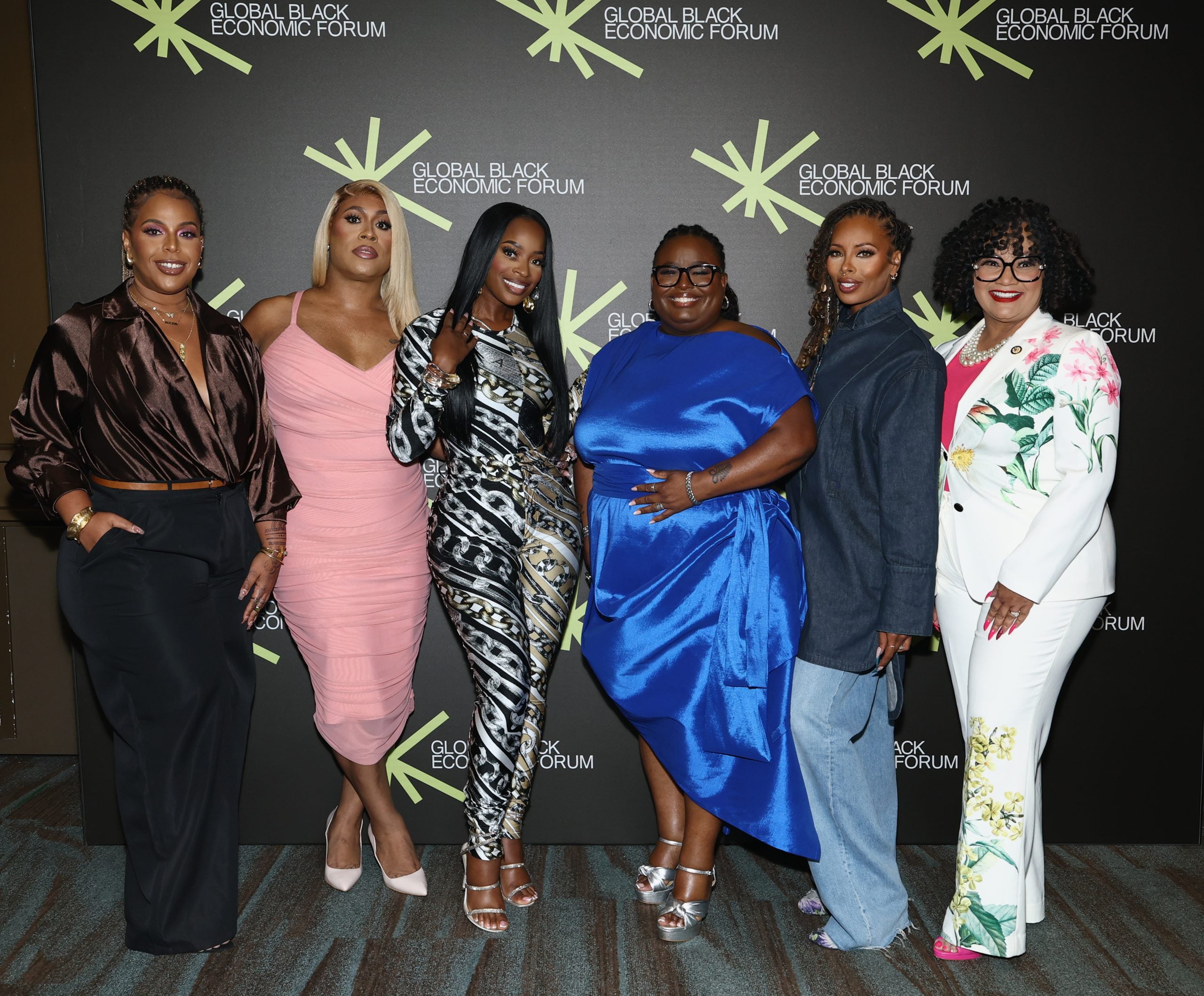
“You gotta move people before you move systems.” With that declaration, Kenya Parham, Chief Growth Officer of Spill, opened one of the most powerful conversations on the ESSENCE Festival of Culture stage. In a year when Black women’s bodies, choices and futures are under attack, the panel—titled “Bodies, Policy, Sexuality & Culture: An Intersectional Reproductive Justice Experience”—cut through the noise with raw honesty and fierce resolve.
Moderated by SisterSong Executive Director Monica Simpson, the conversation began with Congresswoman Nikema Williams, who spoke directly about what’s at risk. She outlined the impact of the One Big Beautiful Bill signed by President Donald Trump, which could strip health care from millions: “17 million people losing their health care, that means someone in this room, someone you know, someone you love,” she said.
Williams, representing Georgia’s 5th district, stressed bringing this truth to the community: “I’m showing up at the barbershops. I’m showing up at the bar. And any place that the conversations are being held, our people need to hear what is actually happening.” She highlighted that over half the state’s counties lack an OBGYN and most childbirths are Medicaid-covered. “We are cutting Medicaid funding by $1 trillion to give tax cuts to billionaires. That’s not okay.”
As the discussion shifted, actress and model Eva Marcille picked up the thread of disruption, reminding the audience that challenging norms starts from within. “I’m too big for a box. I’m too big for a bag. I’m too big for any of those,” she said. Drawing from her unconventional rise in fashion and now as the lead in BET+’s “All the Queen’s Men,” Marcille reflected on how Black women have always redefined beauty on their own terms. “We live in an unconventional reality, and we make this thing home, we make it ours, no matter where we are.” Her message was clear: when Black women own their identities, the industry doesn’t get to decide what beauty or power looks like.
Parham extended the cultural lens, describing how Spill, a Black-owned social app, shifts power online. “Think about the cultural intelligence you’re feeding to systems trained to operate against you,” she said. “We can’t own the shift if we don’t own the story.”
Dominique Morgan, founder of Starks & Whitiker Consulting, challenged the distortions of Black women’s experiences in celebrity culture. As a Black trans woman, she provided a needed perspective: “Because the justice system doesn’t incarcerate you, does not mean that you are not a terrible person,” she said.
Shamea Morton, artist and “The Real Housewives of Atlanta” alum, closed the panel with personal honesty. Speaking on fertility struggles and body shame, she shared, “The best thing about me being open and confident in who I am: block and delete is my best friend.” Her message: transparency encourages healing. “The more I’m open, the more someone else can be open, honest and vulnerable like me.”