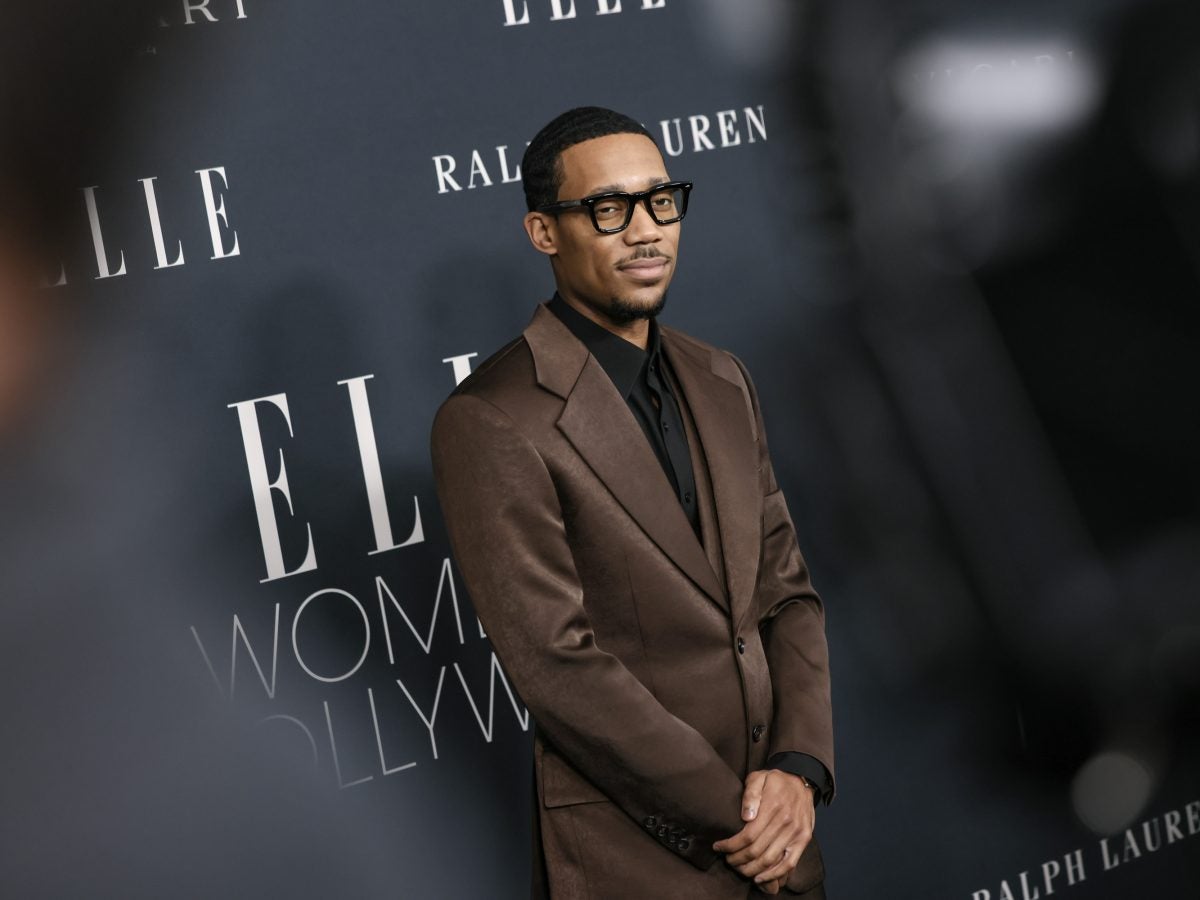

For the entirety of his career, Tyler James Williams has moved with intention. It’s present in the way he speaks, and how he’s crafted a resume that rivals most actors. From child star to Emmy Award-winner, Williams has continued to grow within the film and television industry without compromising his integrity, which is no small feat. For him, staying calculated has always been the key to success.
Although he began his career at the age of 4, he rose to prominence with his role as the titular character in Everybody Hates Chris, followed by dramatic turns in Dear White People and The Walking Dead, and now to his career-defining run on Abbott Elementary. Along the way, Williams has resisted the trap that ensnares so many former child stars: chasing momentum for momentum’s sake. Instead, he’s followed something internal, a gut instinct he trusts above all else.
“There’s always been this feeling that I get that says: You have to do this,” Williams said. “When I get that feeling, no one can really talk me out of it. I’ve even done things when I had that feeling and it may not even particularly do well, but that’s fine. I knew I needed to do it, but I’ve never not gotten something I was supposed to. It’s always been about alignment.”
Williams’ creativity has recently led him behind the camera. Last season, he directed an episode of Abbott, discovering a new lane that sharpened his perspective as an actor. He described directing like being a point guard (one of many basketball references)—seeing the floor, understanding the rhythm, knowing when to lead and when to let others cook. It’s a role that suits him: collaborative, observant, and authoritative at times. Directing has deepened his appreciation for acting, expanding how he moves within a scene and how he understands the machinery around him.
At his core, Williams is still a New Yorker. He speaks about his home team, the Knicks, the same way he talks about his career: alignment, chemistry, patience, and faith that preparation eventually meets opportunity.
“It feels like it’s much like in the industry, you have to take control of your moment,” he said. “You can have a really good idea, but if the timing is not there and the right pieces don’t come together in the right package to get it at, it’s just not going to work. It feels like the [Knicks] have a certain alignment, and we have a roster that can go deep.”
The following conversation flows through it all—Williams’ childhood in the industry, his refusal to live in nostalgia, his hunger to keep growing, and his belief that his best work is still ahead. What emerges is a portrait of an artist who isn’t chasing legacy, but building it in real time, one move at a time.
ESSENCE: You’ve been in the spotlight for as long as I can remember, and few people have been able to transition from child star to adult star the way you have. Can you talk to me about what your experience was like growing up, and how you stayed grounded as a child?
Tyler James Williams: I’m a kid from New York. Being a creative and being an actor was something I always wanted to do. I thought I would be doing theater for the majority of my life or constantly living in New York. Everybody Hates Chris took me to Los Angeles, where the culture is a bit different. I think that’s where a lot of people struggle.
For me, seeing child actors around me from the beginning of their careers through the end helped clarify the intention behind why you’re doing it. I love this. There’s nothing else I love like this. I’m a performer and I’m a storyteller. The desire to be a storyteller for the rest of my life overrode everything else.I wasn’t interested in partying or going out like that. I was more interested in what led to the next job—not just from a “I want to stay busy” perspective, but from wanting to continue to hone my craft and tell my stories. That’s what grounds me. It’s constantly asking what the next story is, how I can push myself outside my comfort zone, and what skill sets I’ve picked up that I can now use and flex those muscles.
Myself, and many of my colleagues—we move like that too. We’re always on to the next thing and don’t really enjoy the fruits of our labor. Do you think you’re guilty of that, or have you been able to step back and enjoy the success you’ve had?
I write in a journal a lot, and I was literally writing about that this morning. I don’t really do that. I feel like it’s an area I need to grow in. I don’t sit back and look at things often. I think that’s another aspect of transitioning as a child actor. I never wanted to be a “nostalgia” artist. I never wanted to be someone constantly talking about what I did 10 or 20 years ago. I want to talk about what’s next on the horizon because I truly believe my best work is ahead of me.
That said, there is something to looking back and taking time, and I want to do that more. I’ve never seen about 95 percent of the work I’ve done. Once it’s finished, I move on. There are entire seasons of Abbott Elementary I’ve never seen and seasons of Everybody Hates Chris I’ve never seen. At some point, I’ll sit back and look at it, but “what’s next” is what drives me. That’s why it’s hard for me to really reminisce.
After your Golden Globe win, Emmy nominations, and the success of Abbott Elementary; did you see your career or life change after winning?
I think there’s a different level of respect that comes with it. Anyone who has studied the industry and people’s career trajectories understands how difficult it is to start where I started and end up where I am now. It’s similar to what happened with Zendaya or Michael B. Jordan—you start as a kid and transition into someone who is respected and award-winning. Very few people do that. What’s nice now is having people trust my ability to do my job, knowing that I’ve been in this industry for almost 30 years. This will actually be my 30th year.
It feels good to have earned that over time. I’m not someone who wants to demand respect before it’s due. I want to make my argument through the work, and I feel like that period of time did that. Now I’m on to making the next one.
You stepped behind the camera to direct an episode of Abbott Elementary, the “Science Fair” episode last season. What was it like directing your castmates?
One of the privileges of directing this show is getting to see every take of everything throughout the entire season. I know this cast very well. I know when something is hilarious, but we’ll probably have to cut it because the scene is too long or we need to end on a specific button. When it’s my turn to direct, I’m really just letting people off the leash. I definitely let Chris Perfetti off the leash a lot. By the time he showed up, he was like, “Oh, you’re directing? Yeah, I’m losing my mind.” And that’s a great thing.
It’s nice to give actors the freedom to make the wildest choices, knowing another actor behind the character will appreciate it. I’d rather see it and decide later if it needs to be cut. There’s a freedom that comes with letting people run and play, and that’s where the best work happens.
Has being behind the camera has affected how you approach acting?
One hundred percent. I think everybody should do it. At a certain point in your career, you start performing in almost three dimensions. You understand what’s happening around you while still being present in the scene. It’s similar to basketball—when you watch a floor general, the game slows down for them. That’s what directing has done for me. I can see where the camera is, how it’s moving, and adjust my performance while staying present.
On Abbott, we also work with kids, which adds another layer because not every take is the same. Being aware of that allows me to move around them and still make the takes usable. I’ve also grown a deep appreciation for our camera department. Their ability to understand us as performers and find us improvisationally is incredible. Directing has given me a greater appreciation for this side of the work, and it’s something I’ll continue doing.
How much do you lean on Quinta when it comes to directing?
A lot. We’ve been working together for about six years. At this point, if I read a scene, I can hear what she’s looking for and see exactly how she wants it to look. I’ll check with her to confirm, but we’ve developed a real shorthand. When you work that closely with someone for so long, it becomes second nature. It gives both of us more freedom in front of and behind the camera because we understand what the other is looking for.
In terms of your versatility, how do you decide which roles to take now?
It’s getting more challenging. I need to feel something when I read a script—a feeling of, “I have to do this.” If I don’t feel that, if it doesn’t move the conversation forward or tell a story we haven’t seen, I’m not interested. Right now, I’m not in a place of doing things just to stay busy. Maybe later in life I’ll want to run the gamut, but right now I’m hungry. If a project doesn’t scare me in some way, it doesn’t interest me. I still feel like I have a lot of room to grow and haven’t challenged myself in every way yet.
You’re always really stylish on the red carpet. When did fashion come into play in your life, and what does it mean to you?
It’s another way to tell a story. I’ve always struggled with being in front of a camera without intention—it felt shallow to me. When we started the awards circuit with Abbott, I became very intentional. If someone is going to take a picture of me, I want to give them something to look at.
There are beautiful designers making incredible clothes, and I want to help keep that aspect of art alive. One way I can contribute is by finding something interesting and giving people a show. For a long time, I was very anti–black suit for that reason. Now I’ve opened that up because I’ve done a wide variety of things, and it depends on how I’m feeling at the time. If I’m going to be in front of people or on their screens, it needs to be art.
When it’s all said and done, how do you want your work to be remembered?
I see it as two parts. I want the work to speak for itself. I want people to look back and see growth—from one project to the next—and know that I gave everything I had from the moment I could walk.
The other part is cultural. As a Black man, I want to make us proud. I may not always hit the mark, but that’s always the intention. When it’s all said and done, I want to be able to say I did my absolute best to tell our stories and represent us well. To me, that’s a good life lived.