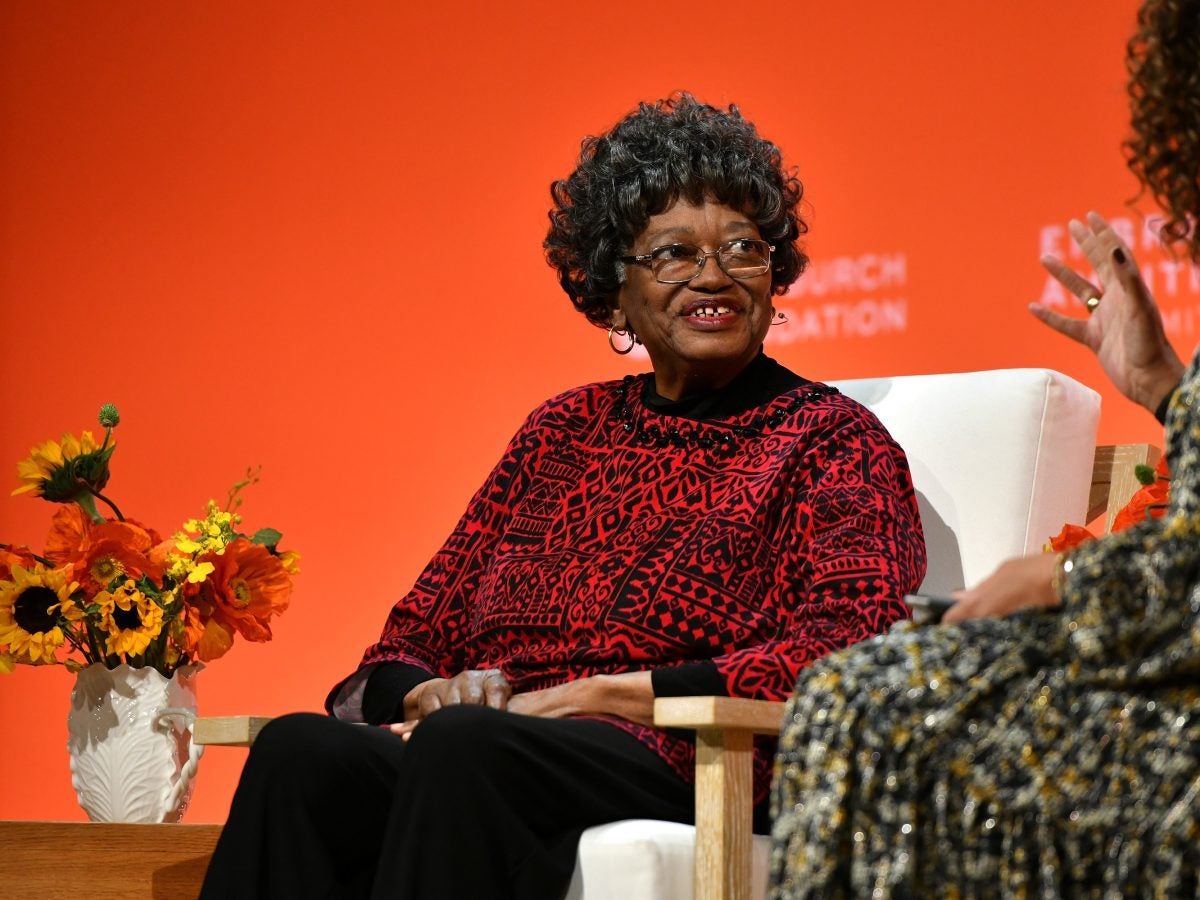

Before Rosa Parks, there was Claudette Colvin. The civil rights pioneer who was only 15 years old when she refused to move her seat on a segregated bus in Montgomery, Alabama, nine months before Rosa Parks’ arrest, died on Tuesday (Jan 13).
Roseboro Holdings, representing the Claudette Colvin Foundation, confirmed the 86-year-old’s death while in hospice care in Texas. Per a statement from the Foundation, “She leaves behind a legacy of courage that helped change the course of American history.”
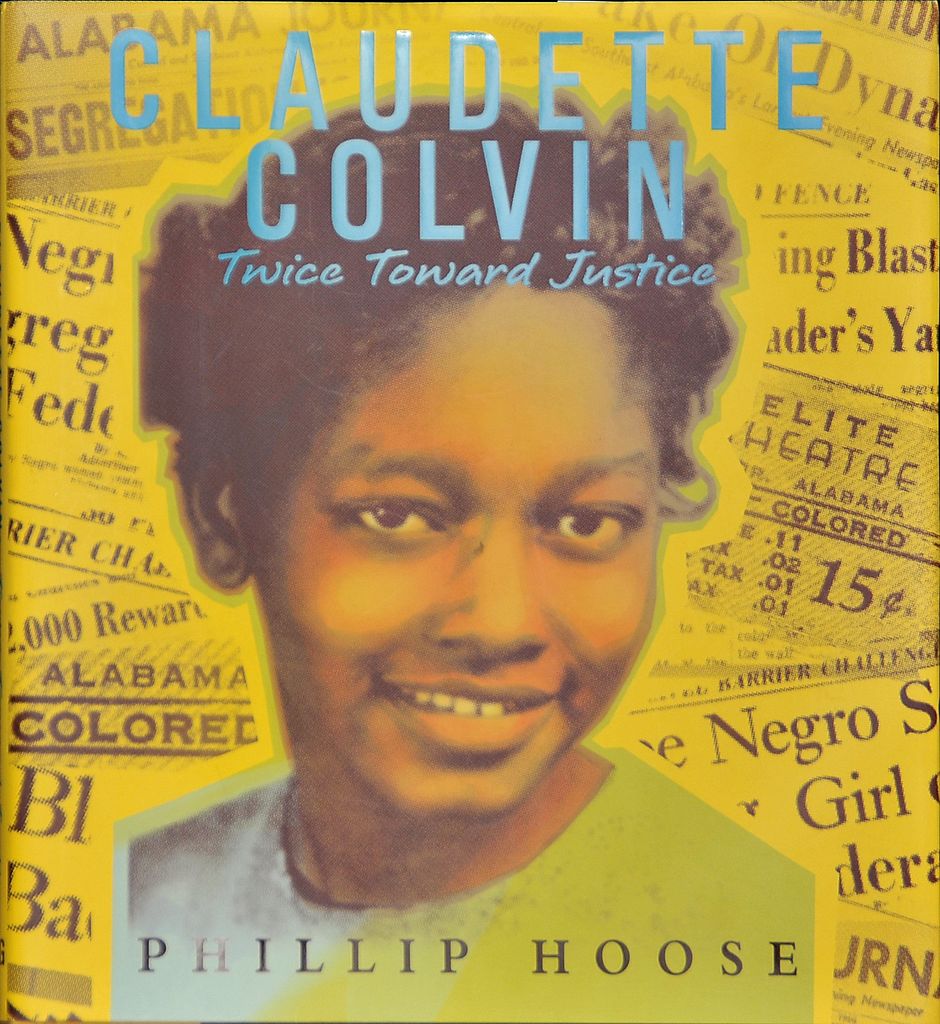
Colvin’s contributions to the Montgomery Bus Boycott had largely been overlooked until the first book about her actions, Claudette Colvin: Twice Towards Justice, was published in 2009. Colvin spoke with the BBC about her experiences in 2018, revealing how she “was not frightened but disappointed and angry” when she chose not to give up her seat.
“Whenever people ask me: ‘Why didn’t you get up when the bus driver asked you?’” recalled Colvin during the BBC interview, “I say it felt as though Harriet Tubman’s hands were pushing me down on one shoulder and Sojourner Truth’s hands were pushing me down on the other shoulder.”
On March 2, 1955, Colvin was making her way home after her high school classes. As was the law at that time, the front rows of the bus were the white section, with Black riders being relegated to the back. “[I]f the white section filled up, the driver could order Black riders to give up their seats if they were in the rows known as ‘no man’s land,’ between the two sections,” The New York Times reports.
Then an active member of the N.A.A.C.P. Youth Council at her school, Colvin had actively been thinking about ways that she could protest the segregation laws in Montgomery. On top of that, one of Colvin’s classmates, Jeremiah Reeves, had recently been arrested for having intercourse with a white woman. Reeves would go on to be convicted, receive a death sentence, and subsequently be executed three years later in 1958.
All of these factors contributed to Colvin’s frame of mind on that fateful day. When a white woman came aboard the bus, the driver demanded that Colvin and the other three Black passengers on her row move to the back of the bus. While two of them complied immediately, Colvin and another woman initially refused. As the situation escalated, the other Black passenger conceded and moved, but Colvin remained steadfast. “History had me glued to the seat,” said Colvin in 2021.
The police literally dragged her off the bus and into a patrol car. While riding in the back, Colvin feared for her safety, with the two officers spouting lascivious commentary about her looks and one officer even riding beside her in the back. As she told The Guardian in 2000, “I didn’t know if they were crazy, if they were going to take me to a Klan meeting…I started protecting my crotch. I was afraid they might rape me.”
Fortunately, Colvin’s fears did not come to fruition. Although she was charged with assaulting a police officer, disturbing the peace, and violating the segregation laws and was convicted in juvenile court, upon appeal, Fred Gray, the lawyer representing Colvin who would later go on to represent Parks as well, was able to get two of the charges dropped; however, the assault charge was upheld and Colvin was fined and given probation.
Initially, Colvin’s arrest made headlines, and many in the Black community believed the timing was ideal for a protest against the city’s segregation laws within the public transit system. So why did Colvin not become the figurehead of the Montgomery Bus Boycott? Colvin believes it was her background that eliminated her from being the civil rights poster child, saying in 2000, “Middle-class Blacks looked down on King Hill. We had unpaved streets and outside toilets. We used to have a lot of juke joints up there, and maybe men would drink too much and get into a fight. It wasn’t a bad area, but it had a reputation.” On top of her lower socioeconomic status, Colvin was purportedly also too dark-skinned, and she became pregnant out of wedlock later that year.
But Colvin wasn’t the only “test case” deemed unsuitable. In October 1955, another Black woman, Mary Louise Smith, endured a similar experience and was arrested, but local activist leader E.D. Nixon alleged that Smith’s father was a drunk despite Smith’s protestations that he abstained from alcohol. Thus, it came to pass that Parks would go on to become the figurehead of the Montgomery Bus Boycott movement alongside Rev. Dr. Martin Luther King Jr. later that year, in December.
In recent years, though, Colvin has reclaimed her space in history, and her legacy remains. She was the first Black person to plead not guilty to charges of violating the bus seating segregation laws. The following year, Gray filed a federal suit on behalf of Colvin and three other Black plaintiffs, citing the unconstitutionality of the city’s bus system’s segregation laws, where she testified as a star witness. They were victorious, and the Supreme Court affirmed the decision in Browder v. Gayle in 1956, which not only paved the way for segregation to end on Montgomery buses but also in public transit systems across the U.S.
Nevertheless, even though Colvin had won a landmark civil rights case, she still had a conviction on her record. In 2021, Colvin filed a petition for expungement and a judge granted her request. “When I think about why I’m seeking to have my name cleared by the state, it is because I believe if that happened it would show the generation growing up now that progress is possible, and things do get better,” said Colvin per the Associated Press. “It will inspire them to make the world better.”
Montgomery recently celebrated the 70th anniversary of the Bus Boycott, and Colvin died a little over a month later. Steven Reed, Mayor of Montgomery, credited Colvin with “help[ing] lay the legal and moral foundation for the movement that would change America.”
“Claudette Colvin’s life reminds us that movements are built not only by those whose names are most familiar, but by those whose courage comes early, quietly, and at great personal cost,” continued Reed. “Her legacy challenges us to tell the full truth of our history and to honor every voice that helped bend the arc toward justice.”