

Hey mamas, it’s Black Breastfeeding Week. Here’s what you need to know to navigate your feeding journey.
Breastfeeding is already one of motherhood’s biggest challenges. But millions of women have to bear the brunt of pumping, pain, and pressure to provide while also taking meetings and putting out fires in the workplace.
The United States notoriously does not mandate any form of paid maternity leave, and most workers are only entitled to a maximum of 12 weeks of unpaid leave, which places many moms in the position of returning to work when their baby is between six to eight weeks old – a huge interruption to the newly formed breastfeeding bond.
National Institute of Health research pinpoints that Black women face even more hurdles beginning and maintaining a breastfeeding journey with our babies, with both the lowest initiation rates and the lowest feeding lengths, according to the CDC.
“I think our biggest barrier is just access and education,” says Ashley Cummings, lactation counselor and RN. “With known healthcare disparities, we already know that we’re not treated the same in the hospital.”
Black women in the U.S. are statistically nine times more likely to be offered formula in the hospital after delivery than their white counterparts, according to the American Academy of Pediatrics. “That initial introduction to breastfeeding is very important.”
On top of racial disparity in postpartum care, social stigmas, and discouragement over the perceived difficulties and inconveniences of breastfeeding, Black women often face added pressure to maintain or exceed previous levels of productivity when returning to the job as a breastfeeding mom.
“It’s also hard when we go back to work because we’re constantly trying to prove ourselves,” says Cummings. “You just have to understand that you’re literally coming back to work as a whole new person, whole new identity, with new responsibilities.”
While she urges breastfeeding mothers to give themselves grace when returning to the workplace, Cummings stresses they should be open with their direct managers and – if necessary – firm with their employers to ensure they are properly accommodated.
Talk to Your Employer
“Feeding your child is your priority,” Cummings says. “I think by setting that with yourself first and foremost, you can prepare yourself to have these conversations with your direct report when you get back to work, and also to know your rights.”
Cummings suggests speaking with management about your intentions to pump or feed while working as soon as possible, and assert your right to do so while on the clock with HR or other higher-ups if the conversation doesn’t go as smoothly as you’d hope. Notably, this can be a daunting thought for a postpartum mother just getting back into the swing of things at work.
“I was nervous to do it,” says chemical engineer Sade Ruffin of broaching the topic with her employer. “Like, I am asking for extra time that other people aren’t taking. I’m asking for a modified work schedule that other people don’t have. So, I definitely had to be intentional about having that conversation.”
As a first-time mom returning to work when her baby was four months old, Ruffin had nerves about requesting special accommodation after being out of the office for so long. “I had to build my case for why my productivity wouldn’t change, why my output wouldn’t change. That conversation was something that I spent a lot of time preparing for.”
Know Your Rights
According to Cummings, the cornerstone of preparing to talk with your employer is knowing exactly what your rights are, whether you work from home or in the office.
“Know that legally, we are entitled to breastfeeding breaks,” she says. “We’re entitled to setting time when we have to breastfeed or when we have to pump. Depending on the size of the workplace, we’re entitled to designated space to pump or to breastfeed.”
The Department of Labor offers a full breakdown and resources on The Fair Labor Standards Act protections for pumping at work for mothers to access.
Hospital benefits call center rep and mom of three, Vanessa Agyeman, was fortunate to have the support of her employer through multiple returns to work while breastfeeding. “We did have a pumping area closed off for moms who were nursing,” she says of her return to the office with her first child. “I just pumped for an hour or 30-minute increments before my lunch break. I was allotted that time per policy.”
But Agyeman’s story isn’t always the case, and many moms will have to assert themselves to get what they need. “Sometimes, unfortunately, people don’t have the support they need when they get back to work,” Cummings says. “But again, it’s your legal right to have this. So if people have their personal issues with it, that’s on them, not on you. You can still do your job and set those times away when you need to pump, because that’s your priority and that’s your focus.”
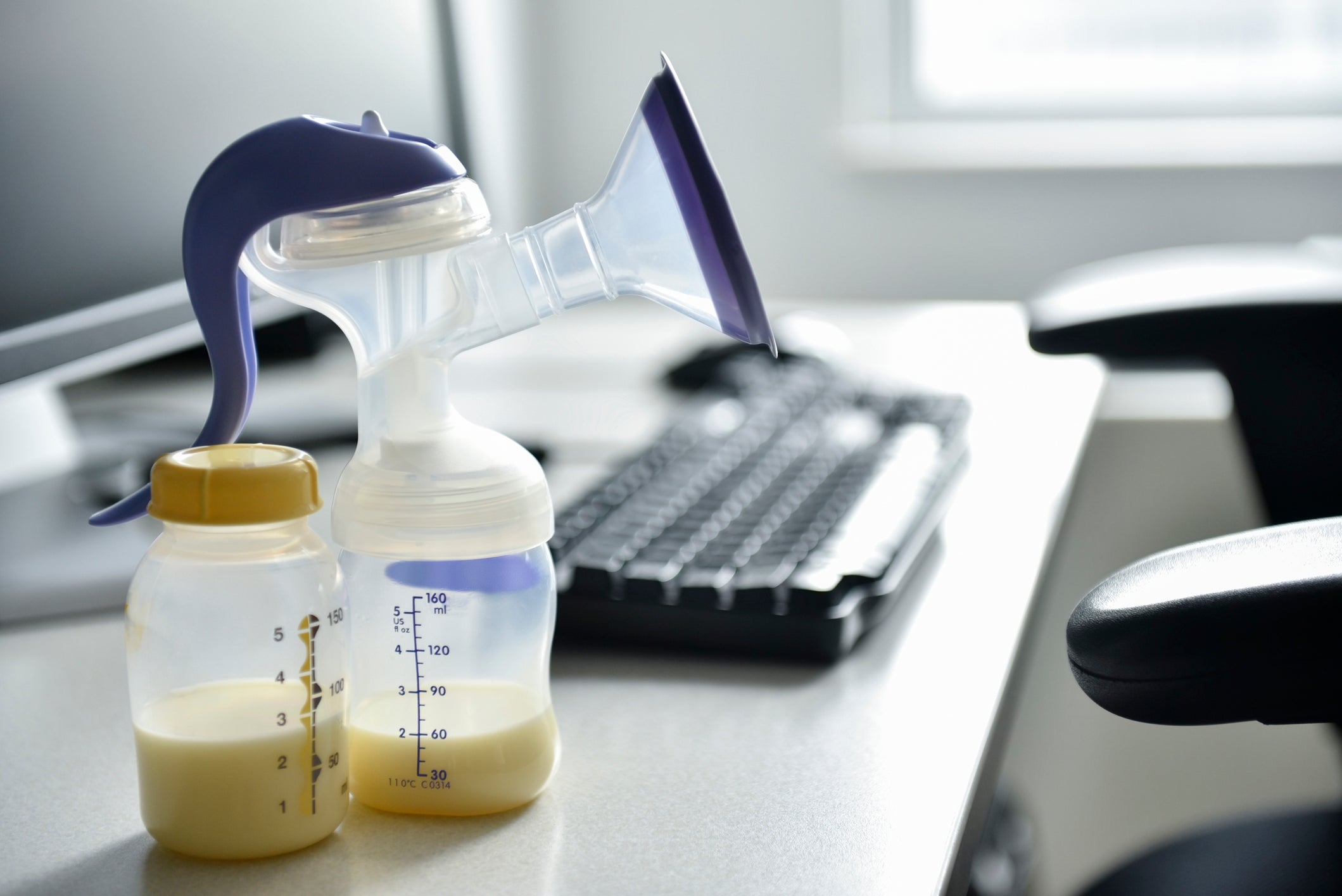
Set Your Schedule
“You definitely need to have a plan,” Cummings says of establishing your new work routine. “And then on that first day back, make sure you set your standard. ‘These are the times that I pump, these are the breaks that I have.’ And even if you have a highly demanding job where you’re going to have to do work after work, like what I had to do, I would also plan that time in.”
Setting a plan and focusing on preparation helped Agyeman stay on track.
“Over the weekend, I would pump enough to supply through midweek, and then keep a pumping schedule while working,” she says. Having shifted from in-office to at-home work between her first and third children, the schedule shifted, but still remained very demanding.
“I do work in the call center, so they can hear the machines going over the phone,” she laughs. “So, when the phones were not ringing, I would pump during those times to try to get what I can for baby. He was on my lap while taking calls, so it was a bit chaotic, but manageable.”
“What I struggle with is trying to stay focused on work while also trying to make sure that I can provide enough milk for my child,” says Ruffin, who also works from home with in-home childcare during the day. She says scheduling pumps and feeds to exact timing has helped her maintain her sanity and her supply.
Fuel Your Feeds
“It’s very true that when you start work, your milk supply is affected, even though I work from home,” Ruffin says. “I am trying to figure out, ‘how do I maintain my milk supply while still trying to be present at work, while still trying to make sure that my baby gets what he needs?’”
Cummings suggests staying on top of nutrition and hydration to maximize output during the pumping breaks you do have.
“Drink eight ounces of water an hour. Continuously drink water all day,” she shares. “Get a big Stanley Cup or other water bottle and have it filled with water throughout the day.”
Adjust Your Perspective
“What’s been big for me is letting go of some of the pressure of my job,” says Ruffin. “My job will be there. My job is not the one taking care of my family. My job is not physically feeding my son. So, I have to prioritize what’s most important to me. And I chose feeding my son.”
“At the end of the day, it’s literally a snapshot of time,” Cummings says of maintaining a pumping and feeding schedule on the job. “It’s not like this is going to be you at work for the next 10 years; it’s only for the amount of time that you decide is best for your journey. And as the child gets older, the timing [naturally] shifts.”