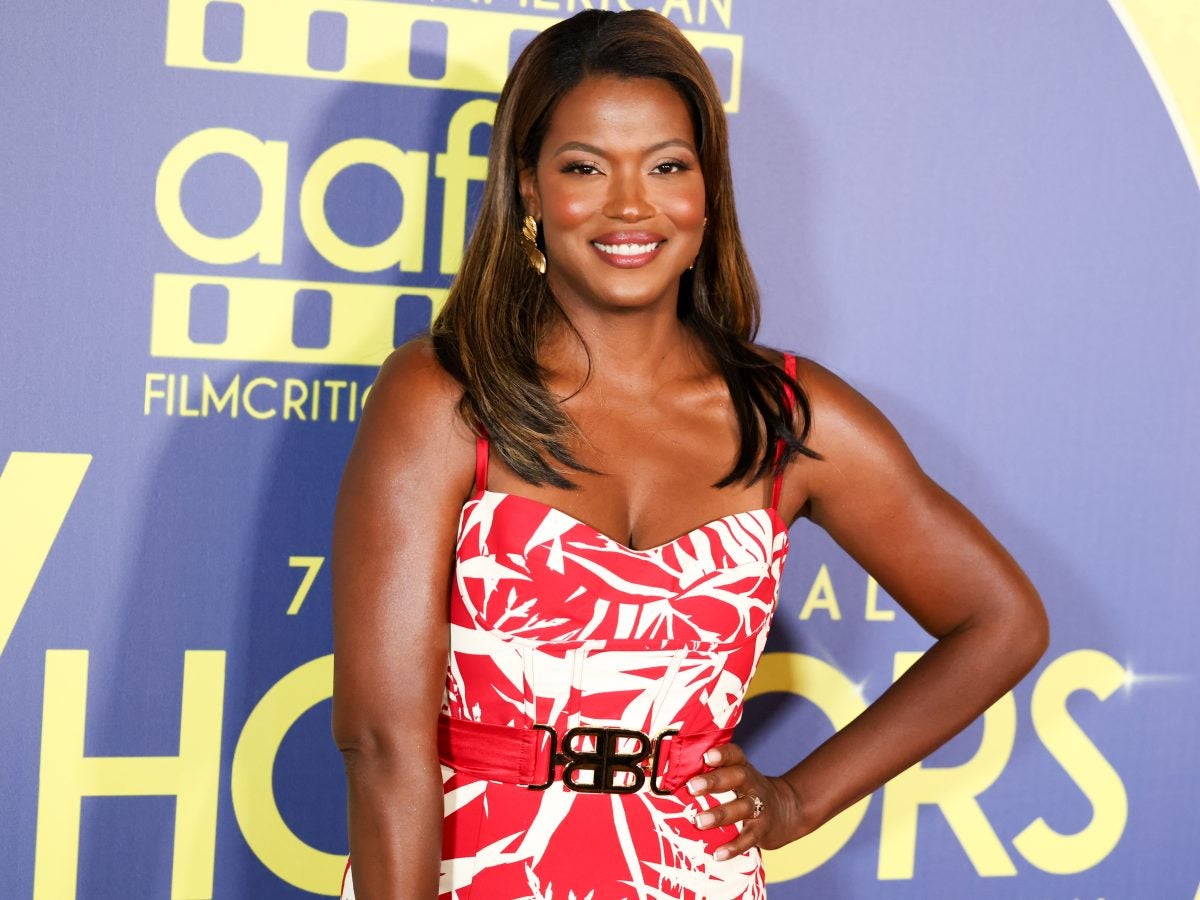

After four seasons, Bel-Air is arriving at its final chapter. Peacock’s dramatic reimagining of the classic sitcom began as a bold experiment, with Morgan Cooper’s viral short turning into a full-scale exploration of Black life, ambition, and the complexities that live inside family dynamics. As the story deepened, the character of Vivian, played masterfully by Cassandra Freeman, emerged. She is the emotional center of the Banks family, a woman navigating legacy and selfhood in equal measure. As the series prepares for its swan song, Freeman’s rendering of Aunt Viv stands as one of the series’ high points: a portrait of a woman reclaiming her creative voice in real time.
Freeman feels unexpectedly energized by the show’s ending. “I’m so excited,” she says. The actress talks about these next eight episodes with joy, and feels at peace with the work she’s done with Bel-Air since its premiere in 2022. She thinks that the timing was perfect—“It’s almost like [Cooper] knew the end from the beginning,” she says. In a way, that mirrors Aunt Viv’s own evolution on the show: each season revealing a new layer, a new texture, a new stroke of intention, until the full portrait finally comes into view.
“Viv starts off so conservative,” Freeman explains of her character in the first season. “She was a woman waiting to bloom.” Early on, Viv’s restraint carried the weight of what audiences historically projected onto Black women: capability without vulnerability, and composure without permission to stretch. But as Freeman kept inhabiting her, Aunt Viv loosened. Her edges softened in some places, but hardened in others. “As the seasons progressed, she became more similar to me than not because I too am an artist,” she says. “She didn’t have a house that allowed her to be who she was. By the end of this fourth season, we are now seeing a woman who’s fully self-expressed.”
The clearest emotional memory of playing Viv, however, didn’t happen during the filming of a scene. It happened when Freeman stepped onto set one day in Season 2 with a new look. “So much of my career has been about dumbing down how beautiful someone might think I am,” she says. “And that was a moment where I wanted to run away. It made me realize how hard this industry has been on my psyche.” It was extremely ironic that this show, which included a heavy, overarching theme about transformation, the actress began to confront her own.
“I didn’t even know I was dark skinned until I got to Hollywood,” Freeman adds. “I was like, am I really this dark skinned to y’all?” she says. “As a dark skinned woman, to cast me as someone beautiful, is a political move. It’s a hard thing to carry.” This version of Aunt Viv is symbolic for many. It pushes against traditional standards and expands the visual language of who gets to be placed at the center.
Towards the show’s finale, Viv’s character arc is reminiscent of the original character, played by Janet Hubert, who is set to make an appearance this season. For Freeman, Hubert’s presence reminded her of the important lineage that she’s a part of. She describes her as “a goddess,” but also effortlessly silly. When the cameras rolled, the experience felt uncannily natural. “It was the easiest acting of my life,” she says. “To look into her eyes, you just feel the truth.”
Although unknown to some, audiences will also see several parallels between Freeman and Vivian in the Peacock series. In real life, she’s a visual artist whose work is vibrant and expressive. “Painting is a mystery and a dance of living in the unknown,” she says. “Certain colors call me and then things just come to life.” Freeman appreciates the control art affords her, and has the ability to shape the beginning, middle, and end herself. “In film, it’s so out of my hands. In painting, I get to be the editor.” Her work is improvisational, instinct-driven, and she approaches performance the same way. “Great acting is surrendering from one second to the next,” she says. “Every take should be so different. Every breath is so different.”
Outside Bel-Air, Freeman continues to stretch her craft. She most recently appeared in the indie breakout Love, Brooklyn, and her creative platform Creatricity is growing into a space designed to connect BIPOC creators with industry decision-makers. She’s also leaning toward comedy again, a genre she once explored through stand-up. Romantic comedies, a one-woman show, even new producing ventures—she’s ready to expand towards whatever her heart desires.
Still, closing the door on Bel-Air is meaningful. Freeman hopes the finale leaves audiences with a renewed sense of collective beauty. “I want people to be like, wow, we are so beautiful. We are so resilient,” she says. She remembers someone once writing to her: “To see your skin made me love my skin.” That, she says, is the note she wants to leave on.
“There’s something revolutionary about telling a story just about love, forgiveness, and family,” Freeman says. “They’re the Banks family, not because of how much money they have, but because of how much real love they have for each other.”