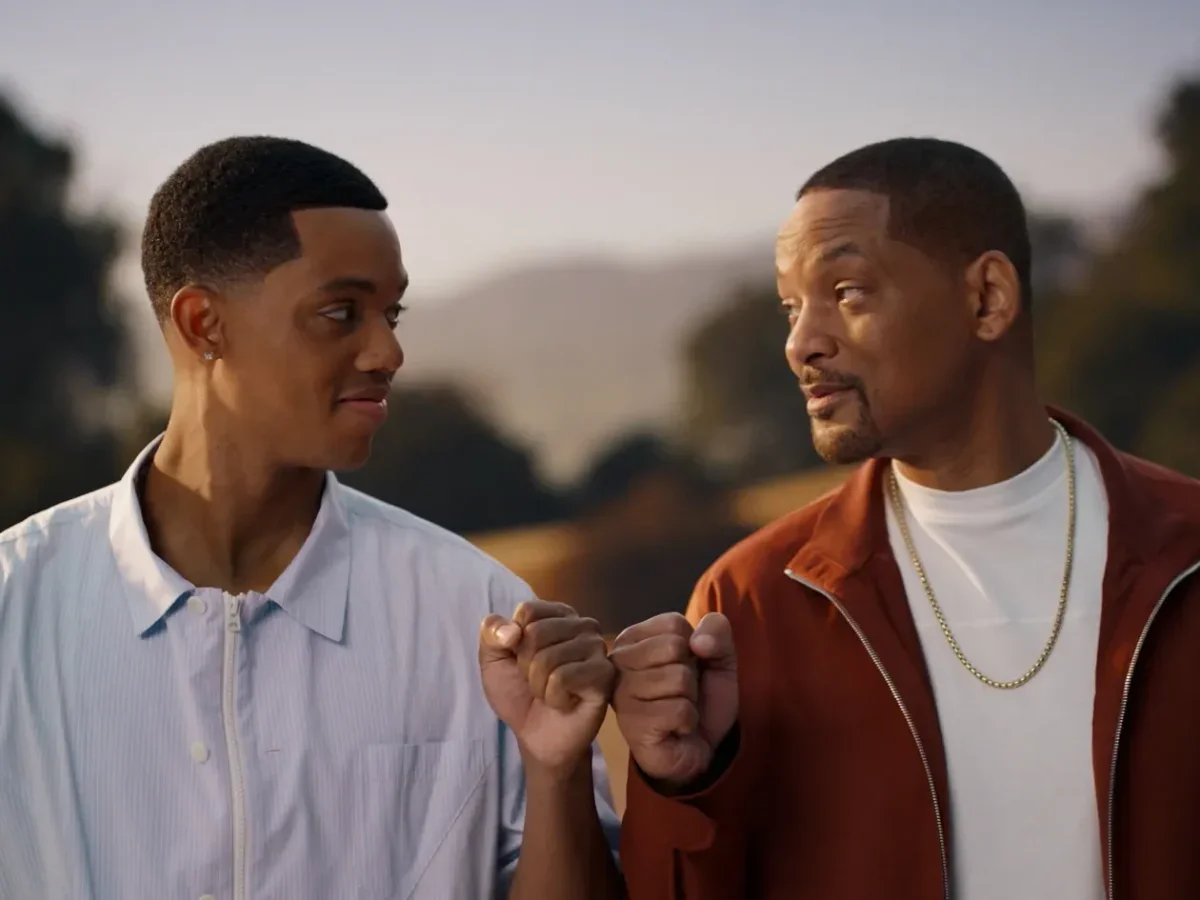

“Life goes by fast, man. Just try to enjoy the ride.”
In the final episode of Peacock’s Bel-Air, things end exactly where they began: Will (Jabari Banks) staring off into the Los Angeles skyline, trying to make sense of his next move. Only this time, he’s not alone. Standing beside him is him—the older, wiser version of himself, played in an absolutely perfect cameo by none other than Will Smith, the original Fresh Prince and an executive producer of the show. It’s a full-circle moment: Smith offering guidance to the character he once embodied, and in some ways, advice to his actual past self, too. The elder Will tells the younger one to embrace change, expect mistakes, and trust that everything unfolds in its time.
On the surface, it’s a clean wrap-up: Will and Carlton head to college, Uncle Phil, Aunt Viv, and baby Nicki trade their mansion for something quieter and closer to Ashley, and Coco Jones’ Hilary returns to L.A., healing and open to whatever comes next. Will Smith was right—life does move fast. And for many fans, so did the run of Bel-Air.
When the series premiered in 2022, it wasn’t supposed to become what it became—a legitimate hit, a weekly conversation piece, and one of the most unlikely pillars of Black TV in recent years. Born from Morgan Cooper’s viral short film, Bel-Air took a sitcom everyone knew and flipped it. While most remakes don’t survive; this one immediately felt like it had something to say. The show tackled serious themes like class, anxiety, mental health, and colorism, while still sneaking in moments of joy and nostalgia. The show also featured appearances from Janet Hubert, Tatyana Ali, Joseph Marcell, Vernee Watson-Johnson, Daphne Maxwell Reid, and Tyra Banks. It didn’t just nod at its predecessor; it welcomed the original family home.
The series earned critical acclaim, awards, and the distinction of becoming Peacock’s most-streamed original series, reaching 8 million accounts. And then, after 38 episodes, it aired its finale. Fans called it premature, some said the industry has a pattern of giving Black-led shows shorter leashes. But there’s also something to be said for ending at your peak, not limping to the finish line. Think about Insecure—Issa Rae wrapped after five seasons (much to the chagrin of fans, critics, and most importantly, Black Twitter) while the show was still a ratings powerhouse. “We told the story we wanted to tell,” Rae said in a 2021 interview. Going out on your own terms is an opportunity that isn’t afforded to everyone, especially with programs that we create.
Carla Banks-Waddles, the showrunner, writer, and executive producer, spoke candidly about the challenge of closing a world this rich in only eight final episodes. “It was very challenging trying to squeeze all these pieces and dreams into eight episodes and have it feel satisfying,” she told ESSENCE. “We have nine talented series regulars, and we wanted each to have a beginning, middle, and hopefully a happy ending. Not a sad goodbye, but a hopeful sendoff.” It’s a tall order, but in many ways Bel-Air managed to tie its loose ends. Whether or not it felt rushed… Well, that’s up to the viewer.
For me, Aunt Viv’s arc—played by Cassandra Freeman—stands as the show’s most rewarding evolution. Banks-Waddles explains why that journey mattered: “The beauty of being in this one-hour space is that we can take a character like Aunt Viv and go deep. She isn’t just the wife and the mother; she has her own fully realized story.” Over its run, we watched her move from supporting her husband’s political ambitions to reclaiming her own creative voice, fighting for her dreams with honesty and unapologetic clarity. “Seeing a woman prioritize herself and have honest conversations about what she needs—it was very satisfying,” Banks-Waddles said. And it was. Aunt Viv had one of the most resonant character journeys not just on Bel-Air, but on television this year.
Of course, endings are hard. Humans are nostalgic. We mourn our favorite childhood toy, re-read old texts from a toxic ex, and keep college T-shirts that should’ve been thrown out three moves ago. A favorite show falls into that same category. As a child, I can remember watching the last season of The Fresh Prince of Bel-Air and feeling like I was saying goodbye to people I knew. The Banks family wasn’t just funny; they were familiar. Watching Will walk out of that empty house felt like the end of something personal.
Change is uncomfortable, but it’s also inevitable. Neither the Banks family nor Bel-Air could stay frozen in place forever. In the final scene of Bel-Air, Will tells his younger self, “We’re gonna be alright.”
And we will.