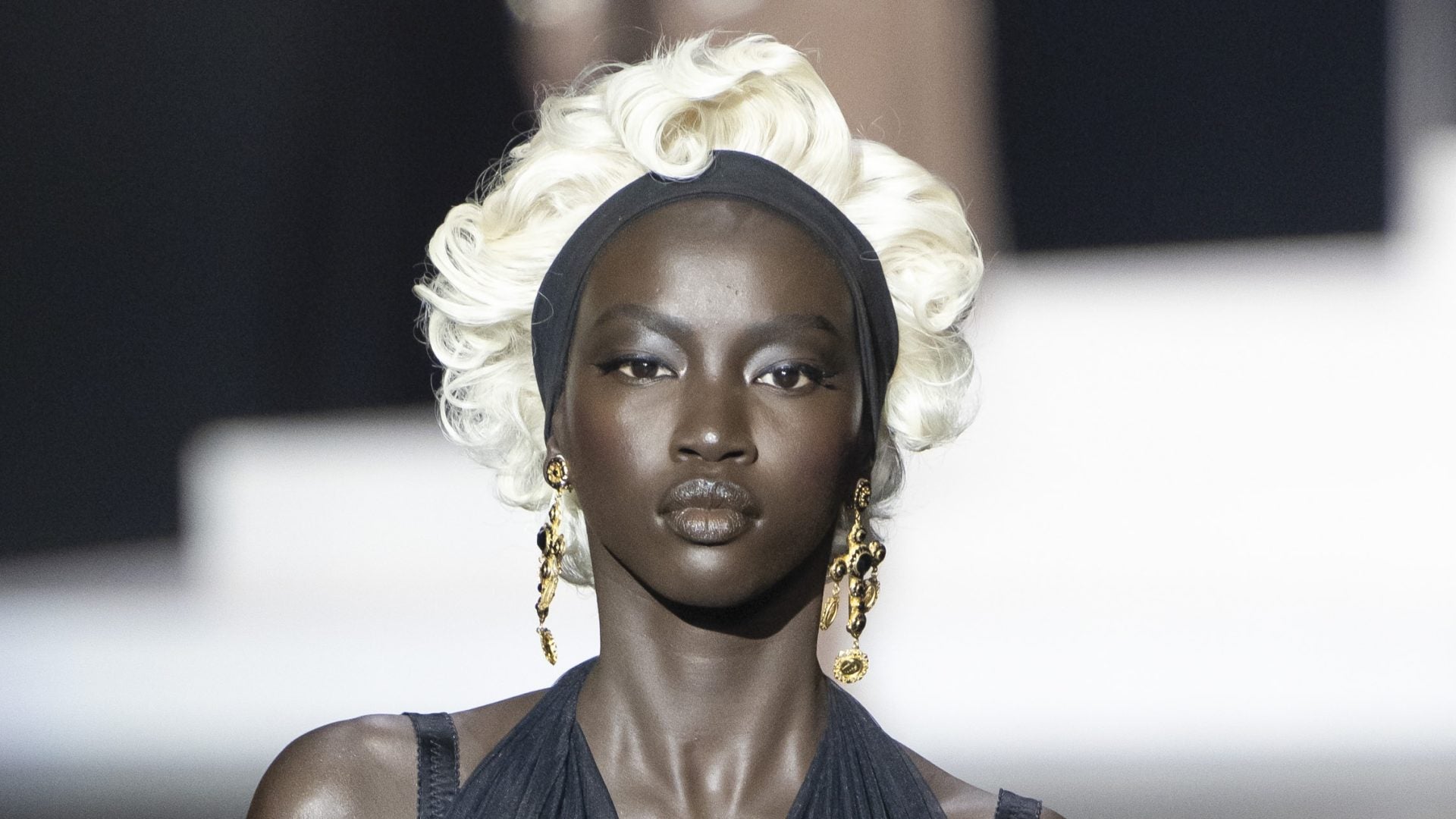

The modeling industry has long been known for its exclusivity—often leaving Black models on the fringes of opportunity and visibility. The few who manage to break through onto major runways and into top editorial spaces remain drastically underrepresented compared to their non-Black counterparts. And even when they do make it in, the challenges don’t stop at the casting call.
For many Black models, the backstage beauty experience becomes a recurring site of microaggressions and neglect—especially when it comes to their hair. Too often, they’re told to arrive with it already styled, an unspoken acknowledgment that the glam teams hired aren’t equipped—or willing—to properly care for textured hair. Others are pressured to alter or cut their hair to make it more “manageable” for stylists who haven’t taken the time to learn. Some are even passed over for certain looks entirely—not because they lack the talent or the look, but because their hair is deemed too “difficult.” In an industry built on aesthetics and transformation, it’s telling whose beauty is considered too complex to touch.
Actor and model Nick Joesten and fashion model Angëër Amol are using their voices to push back, creating a rapidly growing TikTok series that sheds light on the mistreatment of Black hair in the fashion world. “After over a decade in the industry, I’ve seen firsthand how Black hair is treated on set,” says Joesten. “Early on in my career, I noticed most deeper-toned models were asked to cut their hair very short, and that made me uneasy. It was almost as if we needed a certain look to be considered ‘bookable.’ Once I realized I had a platform, I teamed up with my good friend and fellow model Angëër to start a conversation we felt was long overdue.”
Amol echoes that sentiment. “When I first came into the industry, I had locs. When I signed to my agency, they told me I needed to cut my hair. I wasn’t comfortable with it—it took me five years to grow out my locs.”
There’s often a narrow, one-dimensional view of textured hair within the non-Black beauty space. Where we see versatility, strength, and beauty—others see limitations. “I did a Valentino show,” Amol continues. “And it took them four hours to do my hair. All they wanted was braids down with added extensions. That style is easy to do with microlocs.” In that moment, she realized what many Black models have quietly understood for years: textured hair isn’t commonly seen as artful or beautiful—it’s seen as a challenge, a complication, something to work around.
This sense of othering reveals itself in both subtle and blatant ways. Black models are often made to feel like an inconvenience on set—especially when it comes to hair prep. In many cases, they’re expected to do their own hair while their non-Black counterparts receive full glam without question. When their needs aren’t treated as standard, it sends a clear message: your beauty is not the priority here.
“It says that our hair in its natural state is not welcome and doesn’t fit the mold,” Joesten explains. “It tells aspiring Black models that they’ll need to change one of the most integral parts of themselves just to be accepted in this industry.”
Amol recalls a moment shared with her by a close friend, a South Sudanese male model whose name she withheld for privacy. He had flown in from Japan for a shoot, only to arrive on set and be asked to take out his own braids and redo them—by himself—while the glam team focused all their attention on his non-Black counterpart. This is a familiar story, one that underscores a painful truth: when it comes to textured hair, even the most basic forms of care are treated as optional.
“One common pattern is that so many models are just tired—tired of doing their own hair on set, tired of being told to cut it, and tired of constantly having to compromise themselves just to book a job,” says Joesten. “But sadly, that’s the norm.”
What naturally grows from our heads is treated as a point of scrutiny, as if every agent, casting director, and stylist is entitled to an opinion on our hair. It’s presumptuous when you really think about it. Yes, modeling is an aesthetics-driven industry, but for Black models, hair becomes an immediate and ongoing negotiation. As Amol shared, her hair was one of the first things brought up when she put pen to paper with her agency.
She also highlights a double standard that persists across the industry: once Black models are deemed “bookable” with a particular look, they’re expected to stick with it. Change isn’t encouraged or celebrated as it often is for non-Black models; it’s met with silence or skepticism, not empowerment. “When I told my agents I was going to cut my hair, they were fine with it because they’d wanted me to anyway,” Amol recalls. “But they didn’t expect me to cut it as short as I did. I shaved it all the way down—and I didn’t book a single job for over a year and a half.”
Amol’s hair story within the modeling industry, unfortunately, isn’t a unique one. It points to a much larger, systemic issue: the glaring lack of Black hairstylists—or even stylists properly trained in the art that is textured hair. When the professionals tasked with creating beauty looks aren’t equipped or diverse enough to care for all hair types, it falls on the model to show up and do two jobs.
“Over the last ten years, I can count on one hand how many Black hairstylists I’ve worked with,” Joesten shares. “The biggest issue is that Eurocentric hair is still treated as the default factory setting. So many stylists haven’t been taught how to work with textured hair because they’ve never had to.”
Of course, there are Black hairstylists in the industry who are making it a point to elevate textured hair and celebrate its versatility—names like Naeemah LaFond, Jawara, Vernon François, Ursula Stephen, Jabarie Anderson and many more. But the presence of a few shouldn’t be the exception—it should be the norm. There needs to come a point (sooner rather than later) when understanding how to manipulate and transform textured hair becomes a baseline industry standard. Until that happens, Black models will continue to be put in the unfair position of having to sacrifice parts of themselves—whether their hair, identity, or comfort—for the sake of getting booked.
“With fashion, you want hair that’s versatile. And that’s exactly what our hair is,” Amol says. “It can be straightened, curled, braided, shaped—so many things. If a stylist thinks textured hair is difficult, then they’re just being lazy in their artistry.”
The tools and resources exist. The education is available. The issue isn’t access—it’s intention. It’s about whether the industry cares enough to step into those spaces and do the work. Textured hair isn’t difficult. It’s just intentionally misunderstood. And that mindset needs to shift.
“To me, meaningful change looks like Black people being included in all aspects of the industry,” Joesten adds. “From stylists understanding the texture of our hair, to agents and brands actively advocating for us. We need a seat at the table—not just a foot in the door.”