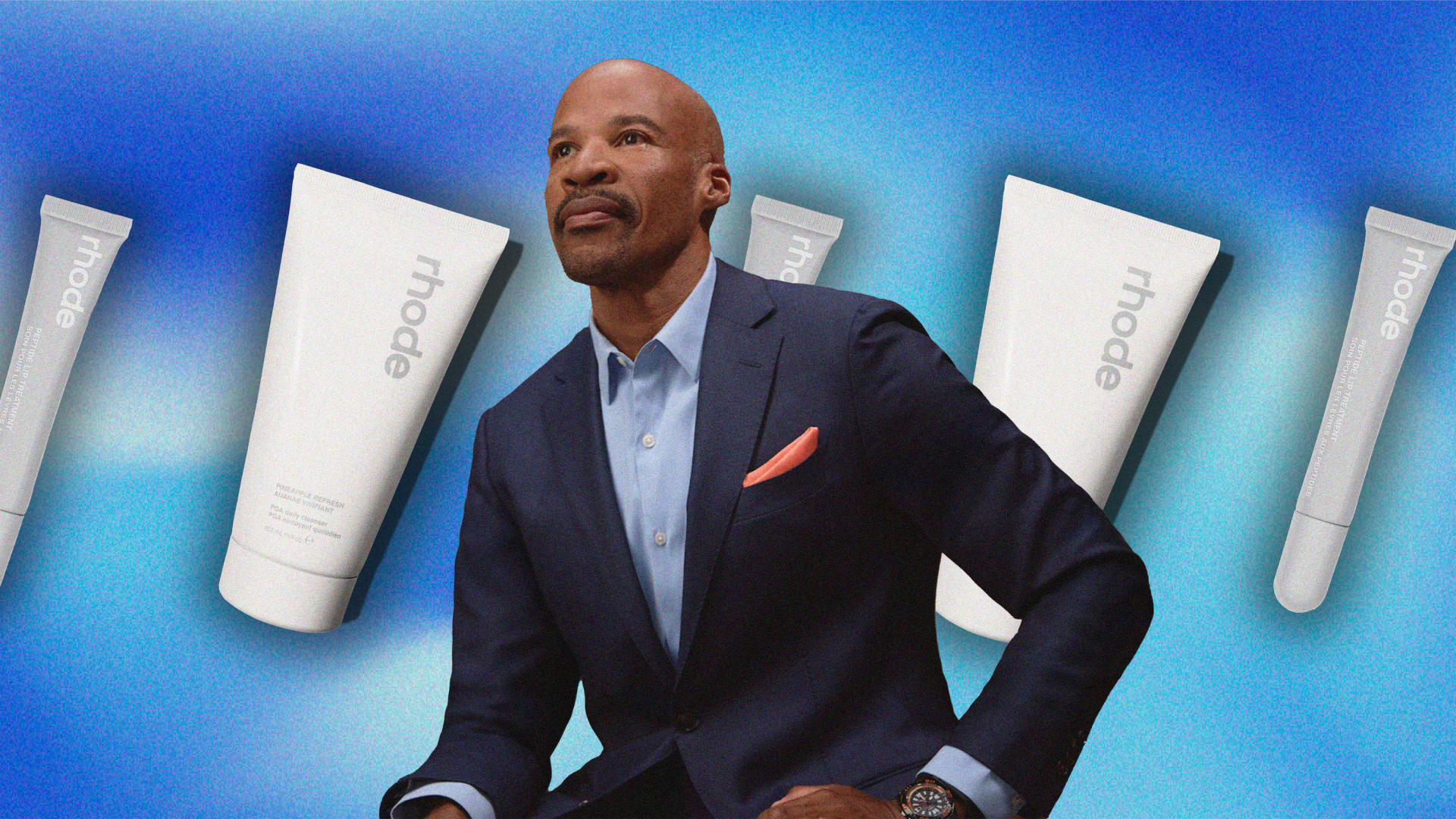

Ron Robinson is the behind-the-scenes scientist for many of your favorite beauty products. Now, he’s taken center stage. First as the founder of the science-backed skincare company BeautyStat, and more recently as an advisor for the celebrity beauty brand Rhode, founded by Hailey Bieber. A champion for diversity, inclusivity, and innovation, Robinson has not only established himself as a scientific trailblazer, but also as a vocal advocate for diversity and performance-first beauty.
Here, Robinson opens up to ESSENCE exclusively about his early days as a cosmetic chemist, how race and representation show up in his field (past and present), the jump to becoming a founder, his relationship with Hailey Bieber and Rhode, and why science-backed skincare—not just celebrity-founded—is the future.
In the Beginning
Robinson refers to himself as an “accidental cosmetic chemist,” but his impact in the beauty industry has been anything but random. Though cosmetic chemistry wasn’t part of his original plan, the influence he’s had on skincare is deliberate and far-reaching. Before developing an interest in beauty and skincare, he was studying biology and chemistry at Adelphi University.
His passion for science came from his parents—particularly his mother, who studied nursing and eventually earned her PhD. “She valued the importance of education and instilled those values in me and my siblings,” he says. At the time, she wanted to become a doctor, but Robinson shares, “it was very difficult for a woman of color to get into this profession—so it was her dream to have her son become [one].”
He pursued a pre-med degree and was accepted into the University of Medicine and Dentistry medical school, but after a year, he dropped out. “I didn’t know what I was going to do,” he recalls. He moved back in with his parents, who “pressured him” to figure it out.
He applied for a role as a cosmetic chemist at Estée Lauder. Unknowingly, it was for the Clinique division. “They hired me on the spot, and from there began my love of the beauty industry and developing great products,” he says.
Race and Representation in the Beauty Industry
Robinson recalls that during his early days at Clinique, he was the only Black chemist. “There were no [Black] people in marketing or in the corporate departments,” he says. This lack of representation often resulted in products that didn’t cater to diverse skin tones or skin types. Rather than being discouraged, Robinson felt empowered. “I saw an opportunity to make a difference and bring a unique perspective to the table.” As he progressed in his career, he realized his presence as a Black chemist “was a form of advocacy in itself.” Being in the room where decisions were made meant he could push for products that centered inclusivity. “I started to see the impact it had on the products we created,” he adds.
At Clinique, Robinson developed the first cream with encapsulated salicylic acid. “This was the first time Clinique ever developed a leave-on treatment that improved skin texture and tone while hydrating the skin,” he says. The product was part of the Clinique Turnaround franchise. “It turned out to be one of the brand’s best-selling products of the ’90s,” he proudly tells ESSENCE. The line is still in existence today.
From Cosmetic Chemist to Beauty Founder
Before BeautyStat became a science-backed skincare brand, it began as a beauty blog and social media agency Robinson founded in 2009. “During that time, I became the go-to cosmetic chemist for beauty editors who were looking for expertise on ingredients and beauty trends,” he says. One of the most popular questions he received was: “Why is vitamin C unstable?”
Knowing it was a potent and effective ingredient, Robinson began trying to stabilize pure vitamin C. After five years and three patents, he succeeded. “The last step was to put our formula in an independent clinical [study] to test and confirm our product delivered,” he explains. The results showed significant improvement in fine lines and wrinkles, skin firmness and tone, hyperpigmentation, and pore visibility. The BeautyStat Universal C Skin Refiner was born. “I had no choice but to launch the beauty brand [in 2019],” he says.
You can find Robinson’s Chem-C™ Technology, his patented blend of vitamin C and peptides, not only in his award-winning Universal C Skin Refiner, but also the Universal C Eye Protector, and his latest launch: C Lip Serum SPF 30, the first vitamin C mineral SPF 30 lip serum on the market.
From Beauty Founder to Beauty Advisor
During the pandemic, Robinson began another pivotal chapter in his career. Hailey Bieber connected with him in 2020 and shared her concept for Rhode. “Hailey floored me with her precise vision for the brand as well as her knowledge of product and texture, and her sophisticated taste level and aesthetic.” She brought him on to help identify ingredients that would deliver meaningful results.
Today, he serves as Cosmetic Chemist in Residence and a member of the skincare advisory board at Rhode. “I help guide product innovation from initial formula to final glaze,” he says with a smile.
While many celebrity beauty brands struggle to gain credibility, Rhode has resonated. According to WWD, in March of this year, the brand’s net sales hit $212 million in a 12-month span. “From a formulation perspective, I think consumers loved the product aesthetics as well as the fact that they delivered results at an accessible price point,” says Robinson.
At the end of May 2025, it was announced that e.l.f. acquired Rhode for $1 billion—$600 million in cash, $200 million in stock, and a potential $200 million more depending on future growth. While Robinson declined to comment on financial details due to contractual agreements, he acknowledges the industry shift. It’s no longer enough to have a name on the label or a plethora of skus. What matters is how involved the founder is, how effective the formulas are, and how directly they connect with consumers.
Performance-Driven Skincare Isn’t a Trend—It’s Here to Stay
“I think Hailey recognized that bringing on a veteran cosmetic chemist to help with product development would be important for establishing credibility with consumers,” says Robinson. With whispers of a recession consumers are becoming more discerning with their spending. According to McKinsey & Company’s State of Beauty 2025 report, the global beauty industry—valued at $441 billion—is beginning to cool. While it grew 7 percent annually from 2022 to 2025, the firm now predicts a 5 percent annual growth rate through 2030.
In a beauty market overwhelmed by options, performance-driven and science-backed skincare is becoming the standard. “I’ve seen firsthand how the current market is saturated with products that are basically just smoke and mirrors,” Robinson shares. Consumers want products that work. They’re not just buying hype anymore.“Beautystat promises to be transparent and help you cut through the clutter because at the end of the day, our goal is the same: to feel confident in our own skin,” says Robinson.
On Legacy
Robinson defines his impact as rooted in “science-backed product innovation that is inclusive, and by helping to educate and inform consumers about skincare ingredients.” He regularly posts viral social content, speaks at conferences, and continues to be a trusted source for editors. His work is also a blueprint for the next generation. “It’s about showing younger chemists that they too can develop inclusive, innovative, and science-driven products,” he says. “It’s also showing them that they too can make positive change in the beauty industry and achieve success.”
Long before diversity was a mandate, Robinson made it his mission—and his legacy. For every chemist who needed to see themselves in the room, he built a door.