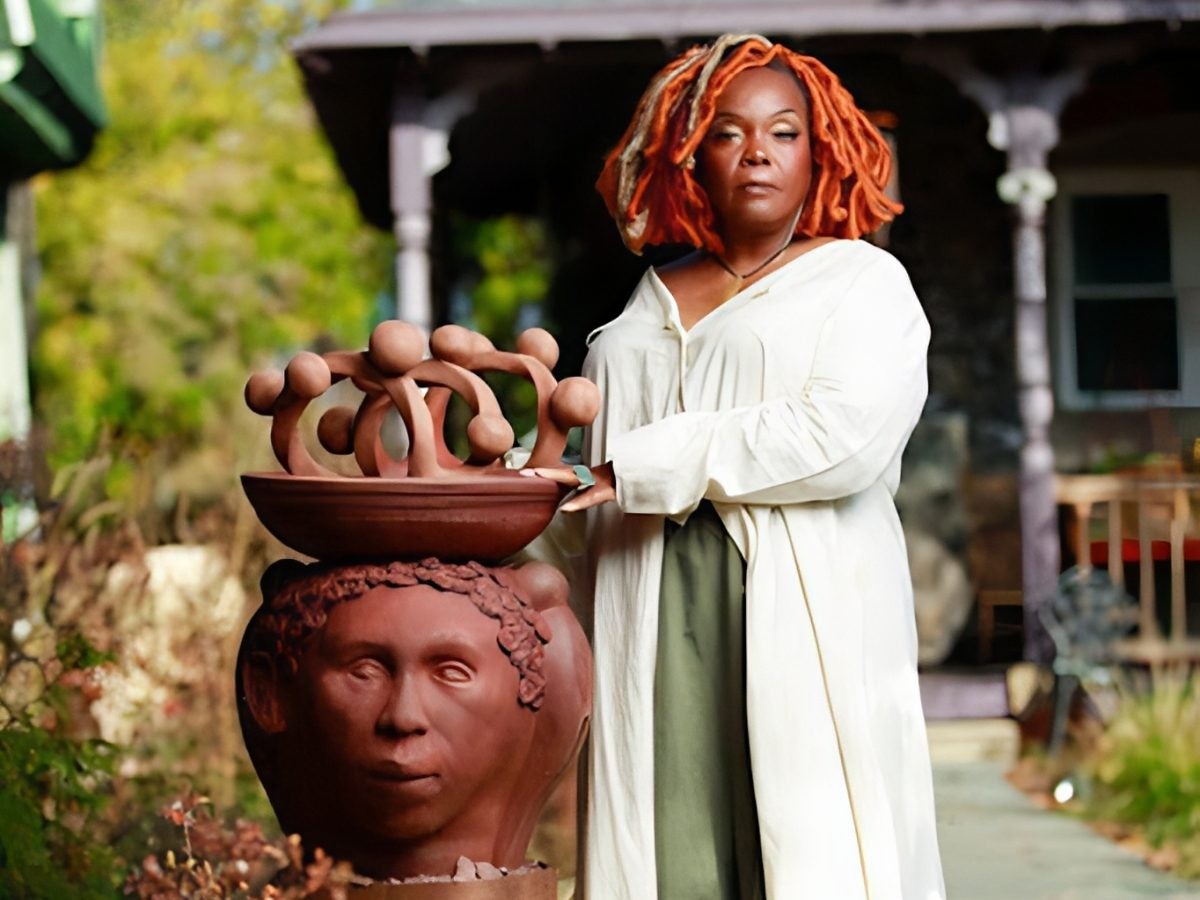

Tucked away in a three-story Victorian home on an ordinary street in Philadelphia’s historic Germantown neighborhood is a museum unlike any other. The Colored Girls Museum (TCGM) isn’t your typical institution—it’s a portal, a sanctuary, and a multiverse intentionally curated to center, celebrate, and protect the everyday experiences of Black girls. Now, a decade since opening its doors, it’s become a cultural landmark and a movement all its own.
Co-founded by Vashti DuBois, Ian Friday and Michael Clemmons, TCGM was born from a deep need to create space for the nuanced and often-overlooked stories of Black girlhood and womanhood.
“We have connected with thousands of people, both locally and globally,” DuBois tells ESSENCE. “Our dedication to arts, culture, and the preservation of Black stories and spaces has made a significant impact. Since we began in 2015, our programming has introduced hundreds of Black and Brown girls not only to the arts, but it has also provided a safe space to explore the impact of Black girlhood. Most importantly, TCGM serves as a blueprint for those who wish to approach things differently and take responsibility for the preservation of our culture.”
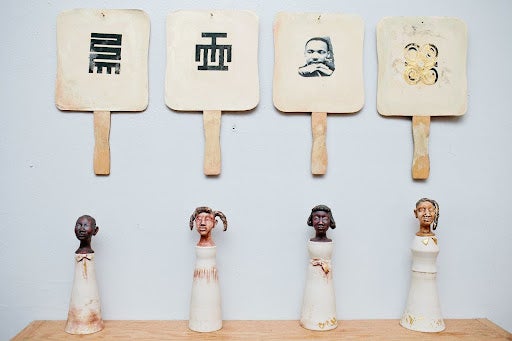
And indeed it has. In ten years, the museum has inspired the emergence of new Black cultural spaces, influenced traditional museums to rethink how they engage with Black communities, and served as a launchpad for countless Black creatives.
From the start, TCGM’s mission has been twofold: to preserve and to propel.
“We believe art and culture are underutilized strategies for economic development in Black communities,” DuBois explains. “Our intention has always been to uplift both emerging and established Black femme artists, and to introduce Black and Brown girls not just to the arts—but to themselves.”
By connecting their youth programming with archival studies, TCGM bridges generations, showing young girls how their present is rooted in a long legacy of creativity, resilience, and beauty. But what truly sets TCGM apart is its radical reimagining of what a museum can be. Located in a regular yet Black-owned home, each room is designed not just to display artwork but to tell a story.
“Treasured family artifacts share space with art from local and global artists,” DuBois says. “Each room is curated to speak to different aspects of the Black experience and how that experience is held in our homes. We center Black girlhood because so much of girlhood is shaped within and by the home environment. It is ever-present; even when our physical bodies grow beyond girlhood, the spirit of that girl remains with us.”
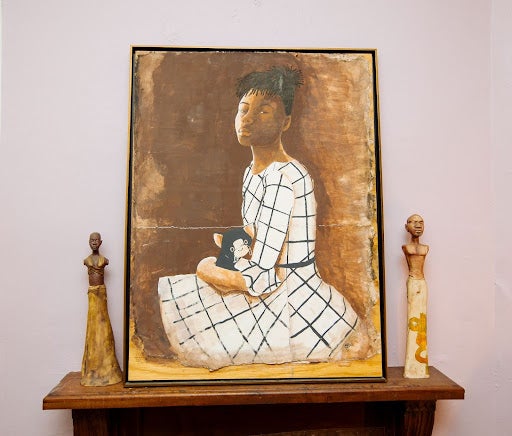
TCGM acts as a third space— it can be a club, a corner store, a schoolhouse or whatever we may need at that moment. “It adapts to our needs,” DuBois notes.
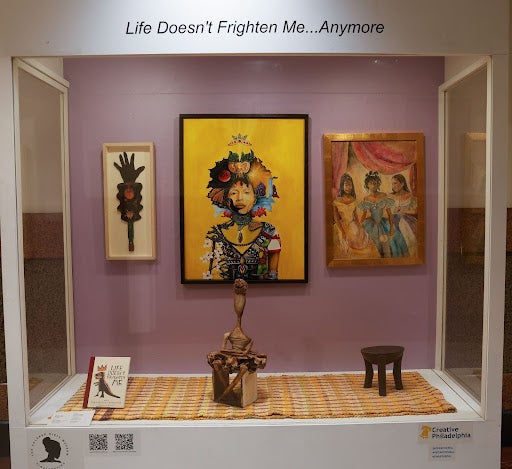
And still, the museum’s impact spans far beyond its front porch. In 2023, an installation at the Philadelphia International Airport brought a slice of the museum to a global audience.
“Travelers and employees stopped in their tracks,” DuBois recalls. “Many said they had never seen Black girlhood honored so publicly, so beautifully.”
At a time when the visibility and valuation of Black women and girls have become more urgent than ever, this space offers something precious: rest. “When Black women and girls arrive at TCGM, they are instantly transported to a different dimension,” the establishment’s founder says. “They intuitively recognize as they pass through the portal gateway that this space has been thoughtfully and lovingly created for them. This awareness gives them a sense of relief right from the moment they enter, as they step into a sanctuary designed with their needs in mind.”
One of the museum’s most radical practices is its curatorial model. DuBois and her team invites everyday Black women and girls to ‘Cure’ate’ (a term coined by the co-founder), by bringing in friends, family, and community members to co-create each space with them.
“This process encourages artists to include their community in their space along with their personal artwork and storytelling,” Vashti shares. “While larger institutions often discuss community engagement, this exemplifies how it should truly look and feel. We also maintain an open call for artists, available online. However, most artists learn about us through our curatorial process, as curators introduce us to new talent.”
As for what’s next? DuBois is thinking big and wide. With the launch of The Mobile Colored Girls Museum starter kit, it allows other communities across the country and globe to create their own versions of the museum.
“There isn’t one single home that can hold our stories. We’re as diverse as our hair textures and skin tones,” says DuBois. “TCGM should exist everywhere. We share our portrait series of everyday colored girls to inspire local artists in other cities to create their own. Those portraits then travel after 3–6 months —it’s like a play date across cities, a traveling celebration of who we are.”
While the Philadelphia house will remain the central hub, TCGM is expanding into something even more powerful than a place. Because in the end, The Colored Girls Museum reminds us of a simple yet profound truth: our stories and experiences matter. Our homes, our girlhoods, our memories— these are worthy of preservation and praise. And in the hands of ordinary colored girls, that truth becomes magic.