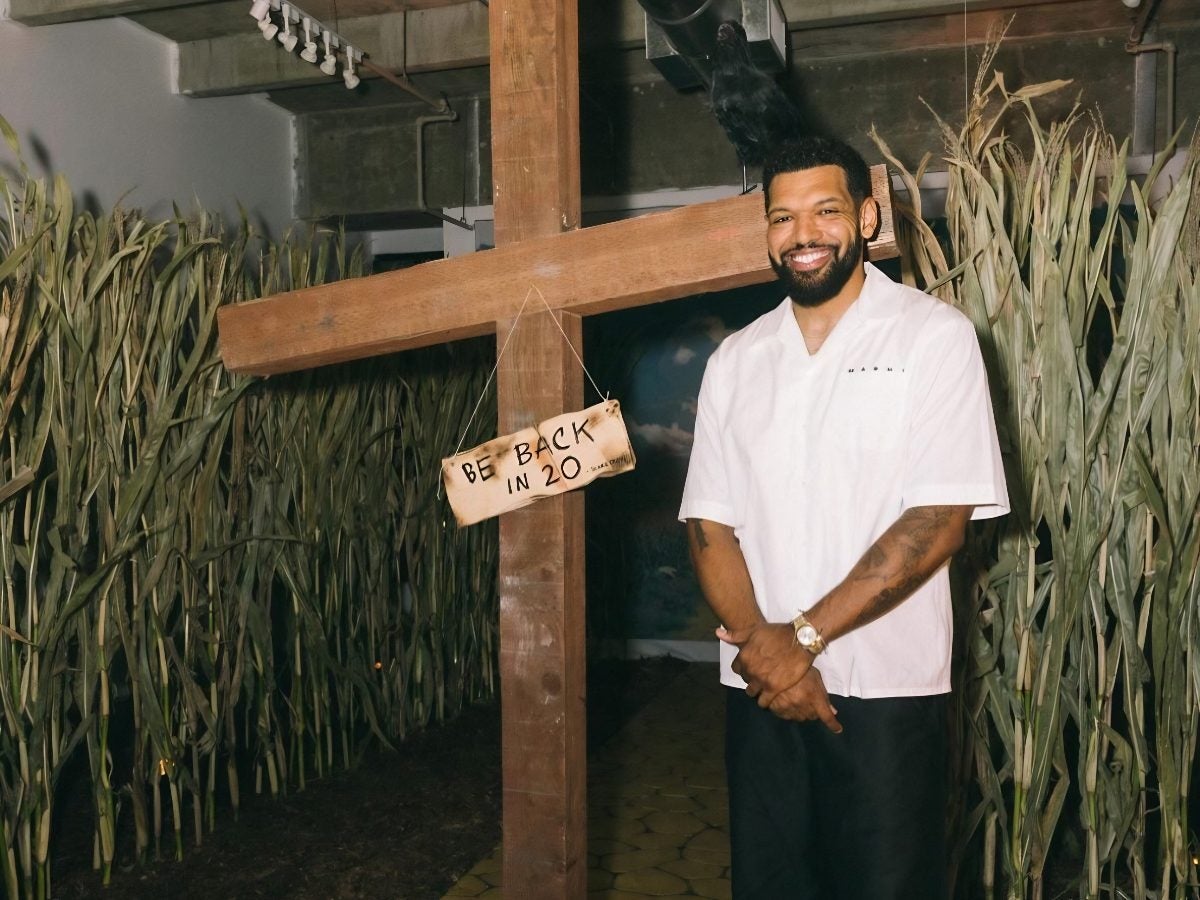

Hebru Brantley has long been known for creating his own imaginative worlds, but with Fields & Phantoms, those worlds expand outward, becoming something viewers can physically step into. Debuting during Miami Art Week at the Miami Design District, the exhibition unfolded across two rooms, drawing from Afrofuturist language and the dreamlike aesthetic of The Wiz. It served as an environment of self-discovery, and signaled what Brantley sees coming next.
After stops in New Orleans, Monaco, Brazil, and New York, FRI&NDS touched down at Miami Art Week, this time with their most ambitious installation yet. Rather than a conventional gallery presentation, Fields & Phantoms transformed its footprint into an immersive work of art, asking viewers to create their own path. The influence of The Wizard of Oz is prevalent; Brantley was drawn to the film’s deeper messaging—how its characters move through fantasy while wrestling with deeply human needs. “The one that I connect to the most as a Black man is The Wiz,” he explained. “That’s the one with soul.”
Brantley’s partnership with FRI&NDS came together organically, as the brand connected with fellow artist and friend Brandon “B.Mike” Odums during Super Bowl weekend. As a creative, naturally, Brantley wanted to expand Fields & Phantoms beyond the realm of a normal exhibition. “I didn’t want to do something typical,” he said. “This also is a precursor to a larger exhibition planned, which delves into more personal aspects of my life, and I’m going to tell a longer narrative, but at the same time, tell something that feels familiar to me.”
Similar to most artists, Brantley is always creating, a sentiment that connects directly to another project the Chicago native has been shaping for years: his upcoming Flyboy graphic novel. When I spoke to him this past summer, he framed the book as a personal milestone. “This has been a long time in the making,” he said. “This is a big goal for 12-year-old Hebru.” Flyboy, a figure that has appeared throughout his paintings and sculptures, had never been given a written arc. Viewers projected their own interpretations, but Brantley had resisted defining an official origin story.
“Flyboy has never had a prescribed narrative,” he said. But for years, he built the world quietly around him—its history, language, politics, even what its people eat. The breakthrough came when trusted collaborators pointed out how complete that universe already was. “Then, I realized I was a lot further along than most people when they aspire to do something like this. I had everything mapped out, and I could answer the questions immediately.”
Brantley also described earlier experiments like Nevermore Park, where visitors entered Flyboy’s universe through physical environments rather than pages. “What does it feel like when instead of paintings on walls, you’re dropping people into an entire new environment?” he asked. “How they engage with it, and how they react… it’s transformative.”
In recent years, Miami Art Week has become a bit commercialized, and many feel that its initial purpose has been lost. But for many artists, it’s still the place to be in December, and Brantley views the week pragmatically. “It’s like art camp,” he said. “You get to connect with a lot of your peers. Towards the end of the week, it does get a little diluted,” he admitted. Still, the sheer density of attention matters. “Under the guise of art week, it brings people out thinking about fine art. And that’s a positive thing.”
Despite his visibility, Brantley still remains connected to the younger version of himself, bursting with ideas. When asked what he would tell that 12-year-old now, his answer was simple. “Be patient,” he said. “Trust the vision.” He spoke about anime, about feeling out of step with peers, about learning not to mute curiosity. The artist also speaks openly about responsibility towards family, lineage, community; and how those pressures shape both his life and his storytelling. “What if you weren’t the one?” he asked. “What if you’re the next one?” The question lingers in Fields & Phantoms, where figures appear mid-journey, carrying something unseen but heavy nonetheless.
“I wrestle with the word “legacy” all the time,” Brantley said. “I aspire to always go beyond. My dad would always tell me, be better than me—not because he was a bad guy, but just go further. And that weight, it falls on you, but you learn how to carry it. After a while, it doesn’t feel like a weight anymore, it just becomes your gravity. You make mistakes, you have pitfalls, but you keep going. And that idea of not being the one, but being the next one—that’s powerful. That’s legacy.”