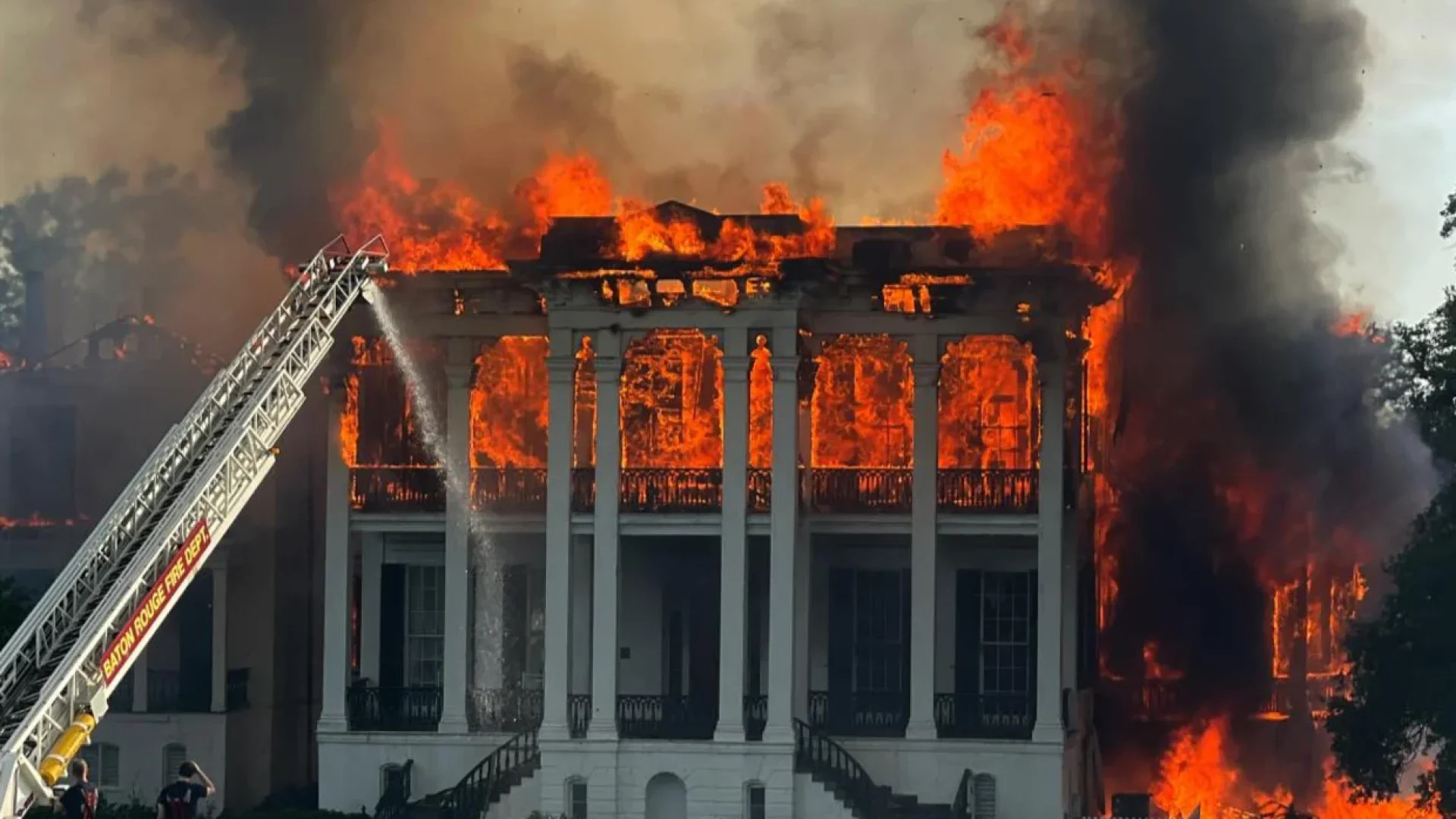

Video footage of Louisiana’s Nottoway Plantation engulfed in flames spread fast on May 15 and the days that followed. What was once the largest antebellum mansion still standing in the South had caught on fire. Around the same time the fire swept through Nottoway, a tree fell and destroyed part of a Confederate museum in North Carolina — an eerie coincidence that felt almost symbolic.
In a country that still struggles to confront its racist legacy, nature seems to be doing what society won’t: tearing down relics of white supremacy. And in a world where the news is far more heartbreaking than heartwarming, my timeline delivered something different with these headlines — a communal joy that felt rooted and ancestral, and for good reason.
Over the last several years, Nottoway had been rebranded by its white owners. The former sugar plantation, built by enslaved people in the 1850s, had become a 40-room “resort” and wedding venue, complete with tennis courts, a swimming pool and a website encouraging guests to stroll beneath towering oak trees named after the children of John Hampden Randolph — the enslaver who had the mansion built.
Nowhere on the official site is there mention of the 155 enslaved people whose labor made this level of opulence possible. That absence is not accidental. It’s a choice. A choice to erase. A choice to sell a fantasy that protects white comfort at the expense of historical truth. It’s representative of a broader American tradition: preserving spaces built on racial violence while silencing those who tell the truth about our shared history.
In March, Trump issued an executive order that aims to restore the statues and monuments that have been removed following the 2020 Black Lives Matter movement. Additionally, the National Museum of African American History and Culture has been targeted by the Trump administration, with reports that the institution has been pressured to remove or reconsider artifacts and resources. Books are being banned in schools and libraries, especially those that speak honestly about race, gender and oppression. Critical Race Theory, an academic framework that helps explain systemic inequality, has been deliberately distorted and used as a political weapon to justify censorship. And the basic concepts of diversity, equity and inclusion have been politicized and inaccurately labeled as “divisive” by those who are fighting for dear life to uphold white supremacy. All while places like Nottoway and Confederate museums are left unbothered by our federal government.
As legal scholar Kimberlé Crenshaw wrote for TIME, “Wiping out our collective memory is part of their targeted strategy to suppress historical literacy, empathy and our capacity to fight for a racially just democracy.” We are watching, in real-time, a fictional rewrite of American history and denial of the very real consequences of a past built on exploitation, genocide, and exclusion.
In an ideal world, the fire at Nottoway would’ve sparked a national conversation about what should be preserved and why. Instead, Nottoway’s owner, William Daniel Dyess, says he hopes to rebuild. He told the New York Post, “I am a lawyer and my wife is a judge. We believe in equal opportunity and rights for everyone… My wife and I had nothing to do with slavery, but we recognized the wrongness of it.”
He went on to say, “We don’t have any interest in left wing radical stuff. We need to move forward on a positive note here, and we are not going to dwell on past racial injustice.” To position slavery as “left wing radical stuff” is simply inaccurate and disgusting. To inhabit a plantation for profit, especially as a white American, and not center its history in slavery is vile and irresponsible. It’s a reflection of the delusional state of our country — where our leaders pretend the worst parts of our past don’t exist in order to protect the fragile feelings of those who benefited from it.
With this current administration, we’re watching our rights, histories and futures be gutted in real time. So yes, there was something undeniably satisfying about seeing people who’ve long profited off our pain experience a little disruption themselves. Nottoway wasn’t a plantation that reckoned truthfully with its past the way some others do. It was a venue that profited off nostalgia while conveniently leaving out the violence and dehumanization that made it possible. That’s not preservation. That’s propaganda. Not only is it misguided — it’s dangerous. The recent fire didn’t just burn a building. It scorched a lie.
Heritage that’s rooted in the erasure of someone else’s humanity should absolutely be remembered — as a cautionary tale. On the other hand, what should be preserved and honored are the stories of resistance, survival, and resilience — not the walls and relics of oppression, but the lives that endured despite them. What we choose to preserve reveals what we value. Right now, America is showing us that it values myth over truth, profit over justice, and hatred over humanity. We have to keep pushing back.