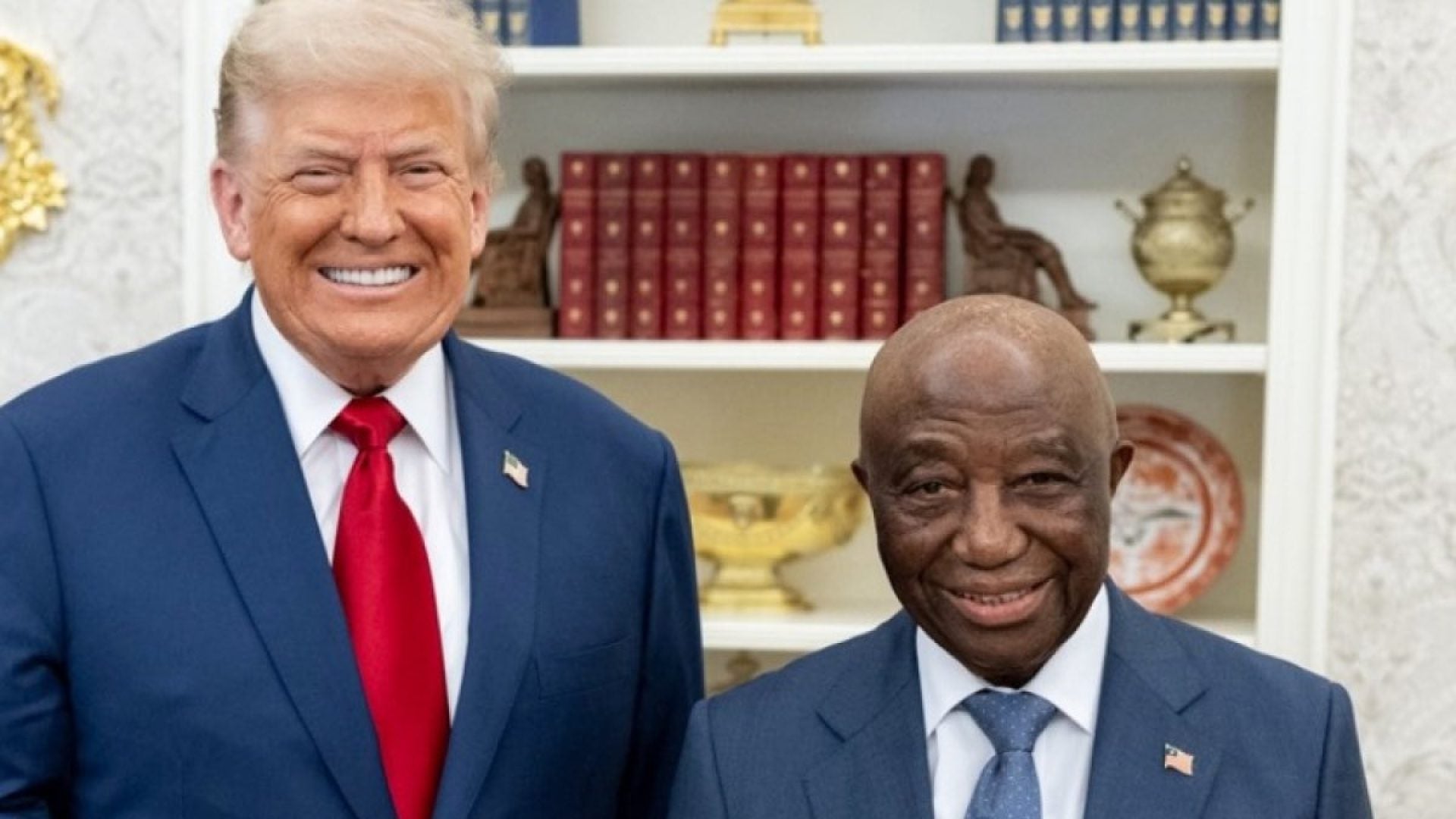

President Donald Trump is once again facing backlash, this time for comments made during a recent meeting with West African leaders that many are calling inappropriate and condescending. His surprise at Liberian President Joseph Boakai’s English drew swift criticism from both Liberians and Black leaders from across the globe.
“Such good English,” Trump said with apparent surprise. “Such beautiful English. Where did you learn to speak so beautifully? Where were you educated? Where? In Liberia?”
The exchange, which happened Wednesday at the White House as part of a diplomatic meeting with leaders from Gabon, Guinea-Bissau, Liberia, Mauritania and Senegal, triggered swift reactions. While Trump’s spokesperson later told NBC News that it was a “heartfelt compliment during a meeting that marked a historic moment for U.S.-Africa relations,” Liberians and others saw it as tone-deaf and patronizing, especially given the country’s deep historic and linguistic ties to the United States.
For context: Liberia’s official language has been English since the 1800s. According to National Geographic, the country was founded in 1822 by freed African Americans through the American Colonization Society (ACS) and declared independence in 1847. ACS, founded in the early 1800s, aimed to relocate free African Americans to Africa, according to the Library of Congress. Ten of Liberia’s presidents were born in the U.S. Liberia’s capital, Monrovia, is named after James Monroe, the fifth U.S. president, who strongly supported the ACS.
“Liberia has always been an English-speaking country. Our president represents a country with a rich educational tradition,” Joe Manley, a Liberian accountant, told BBC News.
Boakai himself didn’t appear fazed by the moment. In a statement to CNN, Liberia’s Foreign Minister Sara Beysolow Nyanti said, “What President Trump heard distinctly was the American influence on our English in Liberia, and the Liberian president is not offended by that.”
She continued, “We know that English has different accents and forms, and so him picking up the distinct intonation that has its roots in American English for us was just recognizing a familiar English version.”
Still, others found Trump’s remarks out of line. Rep. Jasmine Crockett (D-Texas) was among those who publicly called it out. “Trump never misses an opportunity to be racist and wrong, and every day he finds a new way to be embarrassing,” Crockett wrote on X. “I’m pretty sure being blatantly offensive is not how you go about conducting diplomacy.”
Foday Massaquoi, chairman of Liberia’s opposition Congress for Democratic Change-Council of Patriots, echoed that sentiment. “As a matter of fact, it also proves that the West is not taking us seriously as Africans,” he said, as reported by NBC News. “President Trump was condescending, he was very disrespectful to the African leader.”
The moment also drew attention back to the long, complicated relationship between the U.S. and Liberia. Liberia was modeled after the American system of governance and bears cultural similarities, from its flag to the names of its streets and institutions, including the John F. Kennedy Medical Center in Monrovia.
Trump’s remarks during the meeting felt like a slap in the face and a sign that the “big brother” relationship they believed they shared with the U.S. is being redefined. The conversation has put a spotlight on a dynamic that’s hard to ignore: how global leaders, especially from Western nations, talk about and to Africa.
As linguist Nicole Rosen noted in an article via The Conversation published back in March, attitudes toward accents are often “affected by our social knowledge of a person, their accent and where they come from.”
Ultimately, the issue is not just what was said — but what it reveals about centuries of assumptions about Africa and who’s allowed to be seen as educated, articulate or global.