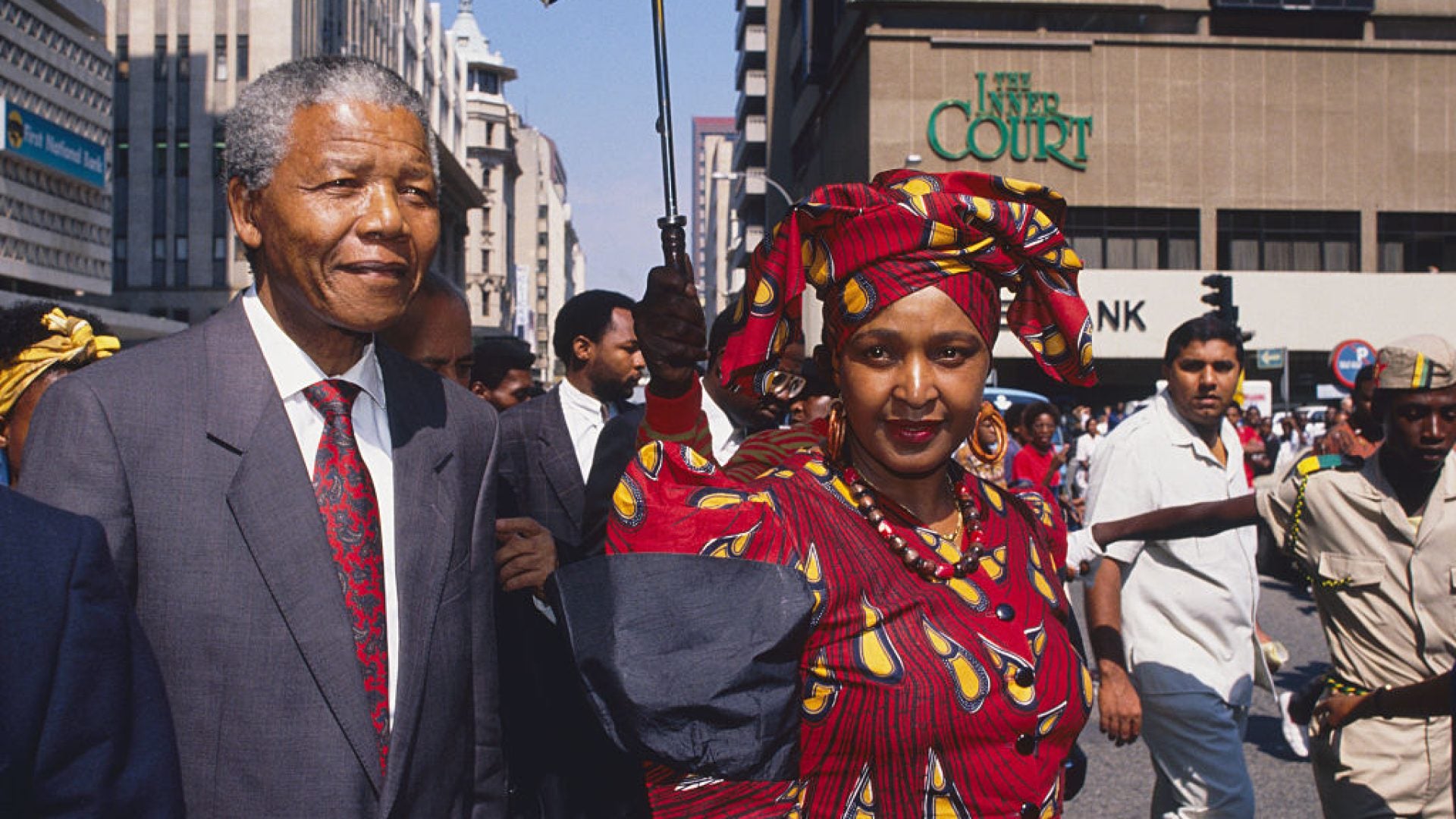

Before Michelle and Barack Obama, there was Winnie and Nelson Mandela. Over the course of the Mandelas’ nearly four-decade long relationship, they established themselves as South Africa’s premiere power couple.
But what exactly is a power couple? According to Cambridge Dictionary, it’s “two people who are married to each other, or in a relationship with each other, and both have extremely successful careers, especially in politics.”
As key figures in the fight for democracy against apartheid in South Africa, it is clear that Winnie and Nelson Mandela meet the abovementioned criteria.
Annually on July 18, the world celebrates Nelson Mandela International Day. This year, ESSENCE is also honoring the “Mother of the Nation” as Winnie was called honorifically.
In her early years, Winnie, who’s been hailed as the “undisputed heroine of the Struggle,” moved to Johannesburg to study social work in 1958. There, she met Nelson and they had their first date at an Indian restaurant near his law office, and the two were married later that year.
That same year, Winnie received her first detention, which “coincided with the mass arrest of women involved in the anti-pass campaign.” In 1962, she received her first banning orders, “which restricted her to Soweto.”
When her husband of four years was arrested in 1962 and sentenced to life in prison, “[s]he was left to raise two young daughters” on her own.
Later, while visiting Nelson on Robben Island, she was arrested in Cape Town and sentenced to a month behind bars.
While her husband was in prison, Winnie “developed a reputation as an uncompromising opponent of the then-predominant racial segregation system.” In 1969 Winnie spent 18 months in solitary confinement in a cell “adjacent to a torture chamber.” On top of being detained and imprisoned numerous times, even once being arrested in her pajamas, her house was also bombed twice.
Winnie was certainly an activist in her own right, for her work campaigning against apartheid. As BBC aptly writes, “at a time when many other anti-apartheid leaders were languishing in jail or in exile, she not only represented the liberation movement. She was The Movement. When she moved, the frontline moved with her. She did not fill the vacuum left by Mr. Mandela. She simply took her rightful place at the centre of the battle for the freedom of black people.”
Even after her death, the legacy of her life cannot be denied. Writing after her death, Charlene Smith, an author and friend of Winnie’s since the 1970s, “Winnie is the Conscience of a Nation that has already forgotten the tragedy of apartheid history; even in her death, people do not realize how she suffered, how damaged she became and how it hurt her and those who cared for her most.”