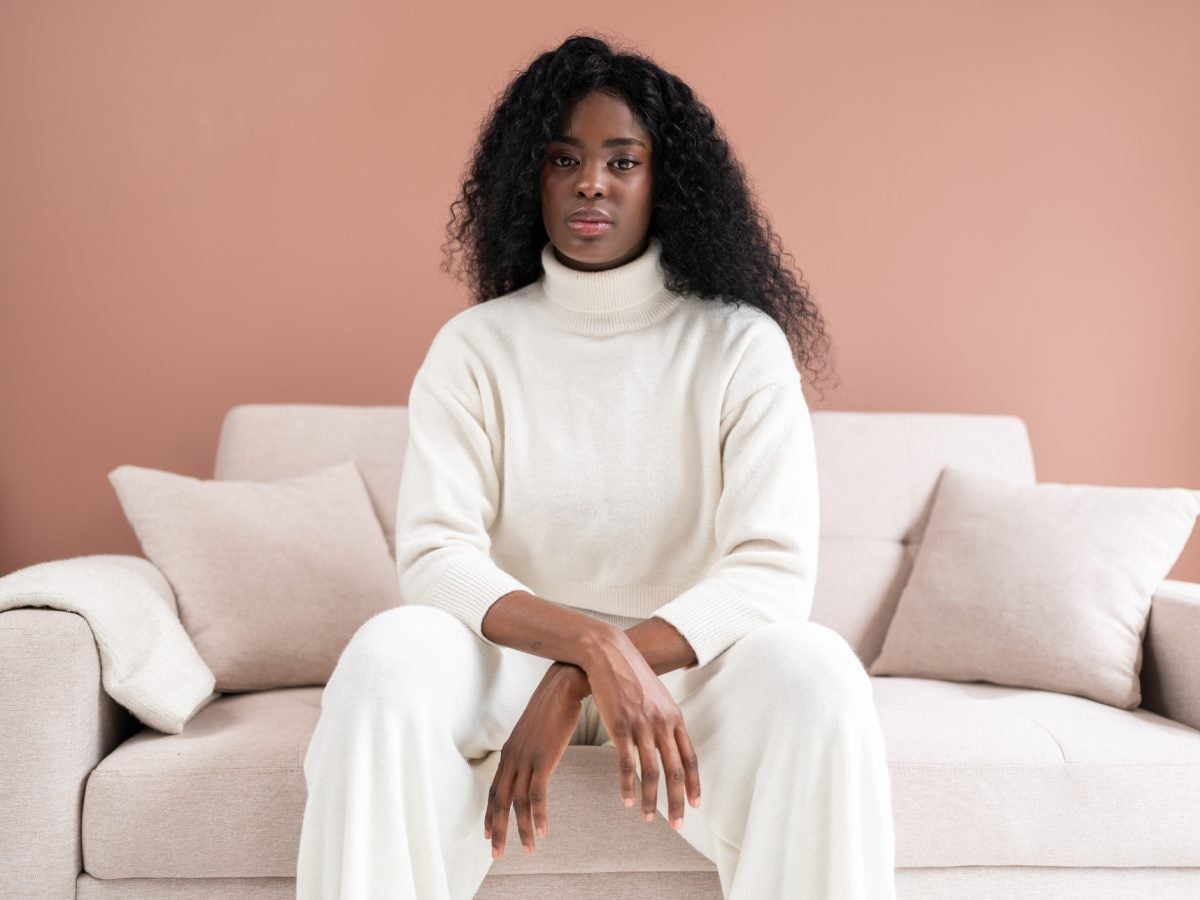

Minimalism has been a mainstay in the wellness and financial spaces for the last decade for good reason. As a lifestyle, it encourages intentional spending and paring belongings to essentials—benefiting your space, wallet, and the environment.
But in practice, minimalism has faced some backlash. For some, it often places style over substance. “Mainstream minimalism looks different from the practice of minimalism—and that’s because it heavily focuses on aesthetics as opposed to people’s authentic styles and the practicality of daily living,” says Christine Platt, author of The Afrominimalist’s Guide to Living With Less. “Very few people can (or want to) live with one fork, one knife, and one spoon.”
Calls to ‘live with less’ can feel tone deaf—or worse, disingenuous for many Black folks in America. To tell a people who, for centuries, have turned repurposing and reusing into an art—transforming food scraps into soul cuisines, Christmas cookie tins into sewing kits, or patches of fabric into quilts that quietly yet confidently display our ancestry and story—out of survival under systemic racism, that they need to ‘declutter’ feels absurd and reductive. Insulting, even. Almost like asking us to do more with even less.
For some, flexing our consumer muscle is the answer. After generations of exclusion from both basic rights and the finer things in life, spending on luxury can feel accessible and self-affirming when addressing wage and wealth disparities feels beyond our control. Black women, for instance, earn 67 cents for every dollar earned by white men, and the median Black household holds about one-eighth the wealth of white households. Yet we are overrepresented in luxury spending: Black women are 72% more likely than average to be considered “upscale fashionistas,” compared to 54% of Asian consumers and 37% of Hispanic consumers. Against that backdrop, luxury purchases carry symbolic weight: not just about owning, but about being seen and taking up space.
But Ashley Viola, a social commentator known for her critiques of capitalism and culture, prompts us to ask a deeper question:Even if luxury feels empowering, what system are we still perpetuating? “Even when luxury is framed as self-affirmation for marginalized groups, it still rests on the same capitalist logic of validation through ownership and exploitation,” says Viola. “While I understand why that performance can feel empowering in a society that denies Black women dignity, we need to remember that true liberation will never come from proving our worth through buying things.”
Liberation comes from getting clear about what we’re truly entitled to: rest, stability, and dignity. “Too many of us are pushed into underpaid, grueling jobs in industries like domestic work, retail, nursing homes, or food service, while also doing unpaid labor at home like raising children, caring for elders, and holding our families and communities together,” says Viola. “Our labor keeps the entire system running, but it’s often made invisible and undervalued.”
A Black minimalist framework, then, needs to blend personal expression, intentional consumption, and political consciousness to challenge us to interrogate our relationship with ownership and consumption—not just what we hold onto, but why we acquire, how we use, and what our choices mean for our communities and the world. Embarking on this journey can start by integrating these principles:
Living With Less, Liberating in Color
1. Understand your why.
Ownership has always carried a double edge for Black people in America—denied property for centuries, then shamed for “wanting too much” once access was partially gained. As Platt reminds us, moving toward a healthier relationship with ownership means reclaiming our power by being intentional. Ask: Why do I want this? Does it align with my needs, values, or story—or is it about performing for someone else? Letting go of items you no longer use, need, or love is not loss and lack—it’s liberation.
2. Be reflective about your authentic style.
Minimalism doesn’t have to mean all-white walls or capsule wardrobes in neutral tones. A Black minimalist approach invites us to express ourselves fully—our culture, our joy, our vibrancy—without drowning in excess. “Look at your home or wardrobe and ask: What actually reflects me? What no longer serves me but could bless someone else?” says Platt.
3. See the global picture.
Viola urges us to think globally. A Black minimalist politic recognizes that what we consume in the U.S. often comes at the expense of Black and brown communities abroad. In Accra, Ghana, for instance, mountains of discarded fast fashion waste from the Global North pile up—what some call waste colonialism. “Clothes cheaply made, overproduced, and unsold in the U.S. often get shipped overseas, dumped in markets, and left for local communities to manage,” says Viola. “These garments are often so poor in quality they can’t be resold or repurposed, so they clog landfills, pollute waterways, and devastate local textile industries.” To be minimalist is to be in solidarity: pushing for labor rights and resisting environmental racism.
4. Experiment with no-spend or low-spend practices.
Trying a “no-buy” or “low-buy” season helps us pause the cycle of overconsumption. We not only save money but also reduce the need to declutter in the first place. To start, decide in advance what’s off-limits (like clothes or takeout) and what’s allowed (groceries, bills, essentials). When the urge to shop hits, swap it with something grounding—call a friend, reorganize, or track your savings—so the practice is easy to sustain.
5. Embrace being “ordinary.”
As Black women, it can be hard to imagine living in a world where our looks aren’t scrutinized or where we don’t dedicate several budget lines to our appearance. “We internalize the idea that our edges always have to be laid, our lace always has to be melted, and we always have to be dressed to the nines to combat the misogynoir that we face,” says Viola. “Conscious consumption rejects the narratives that say Black women have to perform a certain version of femininity to be accepted.”
Minimalism, when made Black, invites us to resist, reclaim, and rediscover. By connecting what we buy, keep, and how we live to the political—how we care for the earth, resist exploitative systems, and fight for equality—we shift from possessions to purpose, carving space for what truly matters and taking a radical step toward collective liberation.
Kara Stevens is founder of The Frugal Feminista and author of heal your relationship with money and Unmasking the Strong Black Woman.