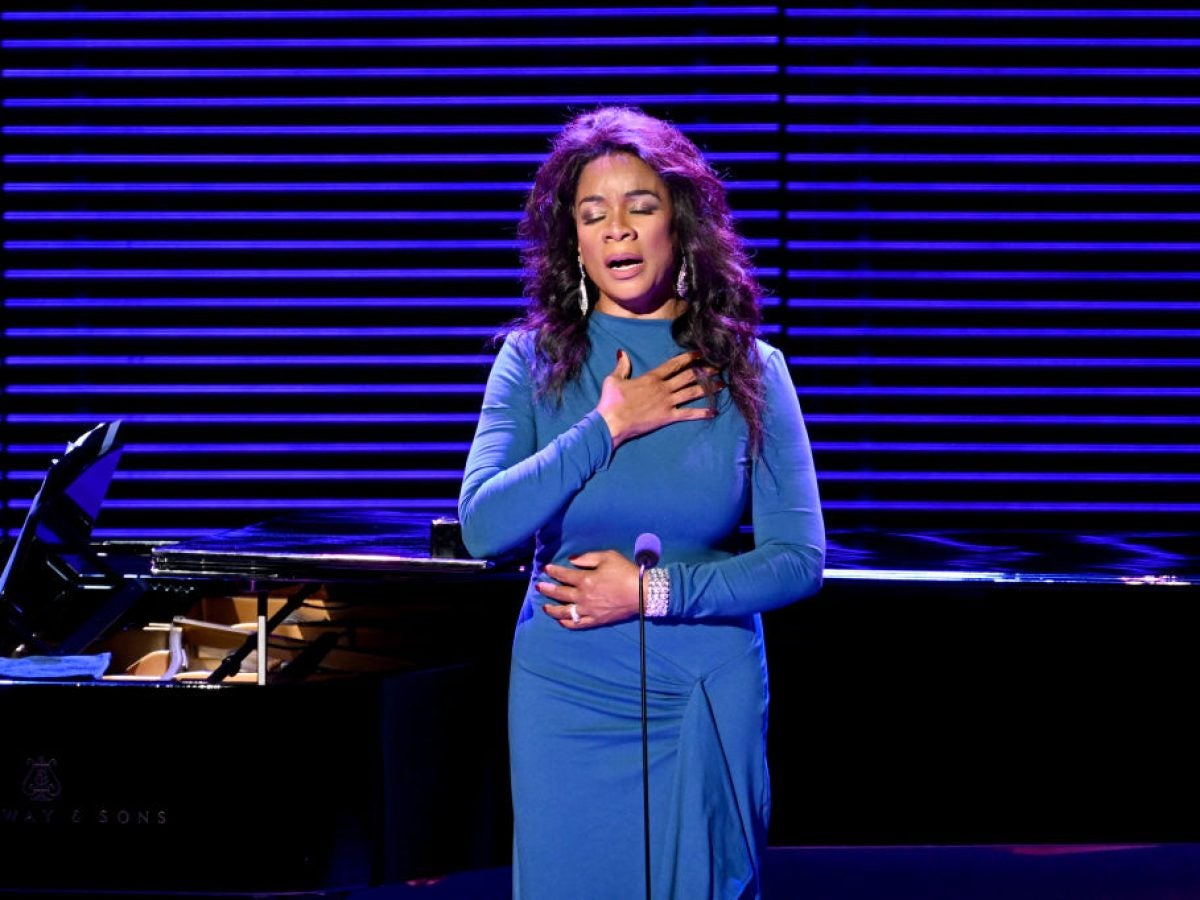

For most of its history, the Metropolitan Opera didn’t think Black women belonged on its stage.
When Marian Anderson finally made her debut there in 1955 as the first Black principal artist, she was 58, which was near the end of her career, not the beginning (there’s a lesson here in that it’s never too late, but that’s another story for another day). It would then be another 6 years before Leontyne Price became the first Black artist to open a Met season.
Forty years after Anderson broke that barrier, Denyce Graves stepped onto the Met stage in 1995 as Carmen—a role that would become her signature. She was 31, and to say that she was on fire would be an understatement. I mean, have you seen the material? Over the next three decades, she’d perform in 158 performances, in roles ranging from the seductive Dalila in Saint-Saëns’s Samson et Dalila to Sally in The Hours. She traveled the world, commanding stages from Vienna to Paris to London.
Now, at 62, and a full career under her belt, she’s walking away. On January 24, Graves will sing Maria in Porgy and Bess at the Met for the last time. But don’t feel sad for this chapter closing, because for Graves, this isn’t a retirement in the traditional sense. Her voice is still strong and she’s still in demand. She’s just done living on other people’s terms.
“I know that I could continue to sing. I know that,” Graves tells me. “I feel that I’m being called to a different place.”
That different place is the Denyce Graves Foundation, where she’s working to fight the erasure of Black history in classical music. Now, she’s finally getting to choose which stories get told and how they’re told. “I’ve portrayed these other characters for so long in my life. I want to portray myself,” she says.
The timing of ending with Porgy and Bess isn’t accidental. The opera holds complicated significance for Black singers, where for decades, it was one of the only major works where Black artists were centered, even as doors to other roles stayed firmly closed. The Met didn’t even stage Porgy until 1985—50 years after it premiered on Broadway.
“I see the retirement around this as a real bowing to the lineage of being an African American woman, and what that has meant,” Graves explains. She sees her farewell as honoring how far things have come since then. “We’re seeing many more stories of relevance, many more stories that speak to the whole African American diaspora.”
But getting here—to a place where she’s making choices instead of just following orders—took decades. Graves grew up in southwest Washington, D.C. in the ’70s with a mother who raised her to “be quiet and reply only when we’re spoken to and be good.” That training stuck. When she got to the world’s great opera houses, she did exactly what she was told.
“Denyce, you go over here, you do this, you sit down, you move when we say move, you jump when we say jump,” she remembers. “And I did all that, and I did it well.”
Somewhere along the way, though, she started paying closer attention to the people in those elite rooms. She was able to rub shoulders with powerful luminaries, the stars with big names. She had made it afterall. But one thought often lingered in the back of her mind: “They’re not smarter than me at all. They don’t have more than I have,” she realized.
It was later when a white colleague once told her the secret to getting what you want that it all clicked: “You have to be prepared to walk away.” Graves wasn’t, not then. She showed up perfectly prepared every time, did everything by the book, while watching others around her make demands and set their own boundaries. “I think I played it safe the whole time,” she admits now.
The pandemic changed something. Watching young protesters in the streets, she felt embarrassed sitting at home. “I thought, ‘If you don’t do anything, then you too are part of the problem.'” She started speaking up more—calling the opera department when her conservatory students weren’t getting stage time and pushing back when theaters tried to control her schedule.
When her daughter needed surgery and a theater said she couldn’t go, Graves drew a line. “This is non-negotiable. I’m not asking your permission. I’m going,” she told them.
That realization (that she didn’t need permission) unlocked something. She started thinking about a football player she’d heard in an interview once. “He said, ‘I don’t think you understand. We’re not asking your permission,'” Graves recalls. “Pandora’s box, at least for me, has been opened. I’m not asking for your permission to live my life.”
These days, what gets her out of bed in the morning isn’t opera. It’s the foundation work. She’s telling “the great stories that have been hidden and that have been erased,” celebrating Black artists who helped build the industry. She sees it as “a straight line to social justice.” When people see the full spectrum of humanity through art, “it changes the playing field. We look at each other differently.”
The lifestyle of opera has lost its appeal too. The constant travel, living out of suitcases, buying yet another bottle of lotion because she left the last one in some hotel room somewhere. “I’ve been doing that part of it, the actual lifestyle piece of it, for 50-something years,” she says. “My body and my spirit doesn’t want to engage in that anymore.”
When I ask what she’d tell her younger self, she says, “Be bolder. Be brave, be courageous, don’t be afraid.”
As for legacy, what she hopes people understand about the woman behind the voice? “That I was honest. No matter what it is that I’ve done, I’ve always tried to come at that with complete vulnerability, complete honesty,” she says. “My work has been my whole self, my honesty, and my whole heart.”
For what comes next, Graves is clear: “I’m choosing the stories that matter to me. I’m choosing the stories that have been neglected, left out, intentionally erased.”
The Metropolitan Opera will see Denyce Graves for the last time on January 24. Thank you, sis, for a job well done.