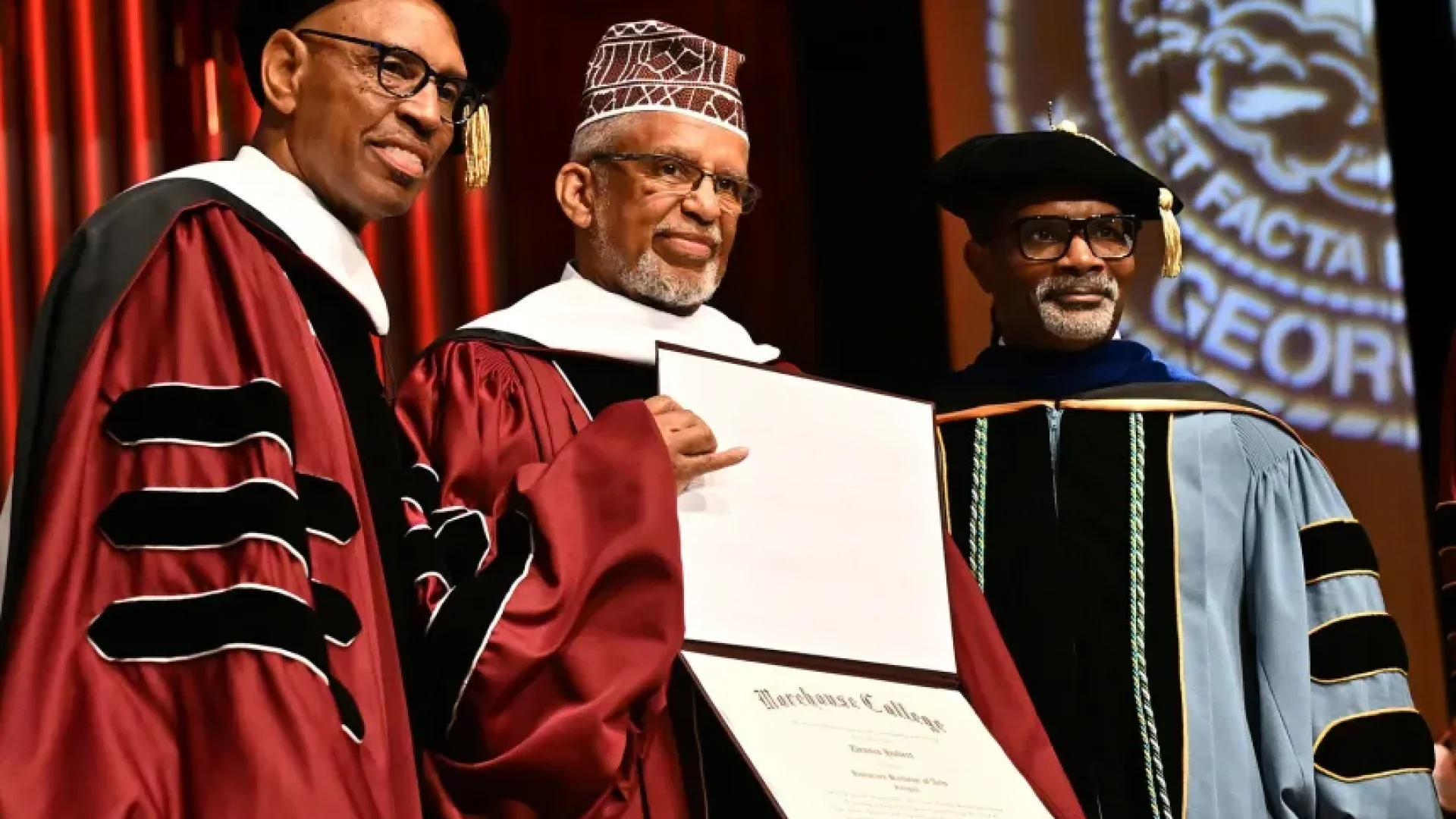

Nearly 95 years after 18-year-old Dennis Hubert was lynched in Atlanta, Morehouse College has posthumously awarded him a bachelor’s degree.
The degree was accepted by his nephew, Imam Plemon El-Amin, during Morehouse’s commencement ceremony on May 18. Hubert, a sophomore divinity student in 1930, was killed before he ever had the chance to earn his degree or meet the family members who would go on to carry his story.
El-Amin, now 75, proudly accepted the Bachelor of Arts in religion on behalf of his uncle, whose life was cut short by racial violence.
“Many prayers were said in his name,” El-Amin said according to CNN.“Many people remembered him and were informed about his life and his legacy, and so the knowledge was there, as well as the charity of him sacrificing his life so that we would be more conscious of the value of young life and the value of human life, but also the value of justice.”
During the ceremony, Morehouse President David Thomas honored Hubert as “a son of Morehouse, a martyr of justice, and what history now sees as the Trayvon Martin of the 1930s in Atlanta,” CNN reported.
El-Amin said his family’s ties to Morehouse run deep, spanning generations. Over the years, 10 men in his family have graduated from the historically Black college — and seven women have earned their degrees from its sister school, Spelman College.
“I was proud of Morehouse to give Dennis the honor, and I’m quite appreciative,” El-Amin said. “The whole Hubert family is really appreciative of that.”
Hubert was killed on June 15, 1930, after spending the day visiting his mother and grandmother. Later that afternoon, he walked to the playground at Crogman School, a segregated school for Black children. He had been there for less than 15 minutes when seven white men approached and accused him of insulting a white woman, according to the Equal Justice Initiative (EJI).
Despite Hubert’s denial — “What do you want of me? I have done nothing,” one witness recalled him saying — the men began to beat him. One of them pulled out a gun and shot Hubert in the back of the head at point-blank range in front of at least two dozen witnesses.
EJI, a nonprofit led by civil rights attorney Bryan Stevenson, documented the attack as part of its work to confront racial injustice and memorialize victims of lynching. The group notes that Hubert’s killing was one of more than 4,000 lynchings of Black people that occurred in the South between 1877 and 1950.
What happened after Hubert’s death only added to the horror his family endured. The seven white men involved in the attack were arrested — a rare step at the time — but just days after they were denied bail, Hubert’s father’s home was intentionally set on fire. He was a beloved pastor in the community. A local Baptist church that had tried to raise money to support the prosecution was tear-gassed.
“A few days later, Dennis’s cousin, Rev. Charles R. Hubert, narrowly escaped an attempted murder,” the EJI wrote. “The chapel for Morehouse sister college, Spelman College, was attacked by night riders who threw stones and shattered the chapel’s lamps.”
Even with eyewitnesses, the seven men were acquitted of murder. One was sentenced to just two years in prison for firing the fatal shot. Another received 12 to 15 years for voluntary manslaughter. The rest were not held accountable.
Now, nearly a century later, Hubert’s name and story are being uplifted — not erased.
“Ninety-five years later, people are conscious of his life, which means he’s still alive,” El-Amin said, according to CNN. “Though not here with us physically or in body, his life, his will, and he is providing inspiration for those of us left behind.”