

Bruce’s Beach, one of the most prominent Black-owned resorts by the sea in Los Angeles, is having a long-overdue righting of a wrong committed a century ago.
According to a report by ABC7, Los Angeles County Supervisor Janice Hahn has announced the return of a scenic parcel of Manhattan Beach land to the descendants of a Black couple who operated a beach resort that was given the Them: Covenant-treatment by residents and ultimately condemned and seized by the city. To this day, the Bruce’s Beach plaque sits atop of the hill as transferring the remaining portions of Willa and Charles Bruce’s land requires state legislation to remove restrictions on the land, which now houses the county’s lifeguard training center.
“I learned very quickly that I just can’t give the property back,” Hahn said during a news conference overlooking the parcel near the Strand and 26th Street. “It came with restrictions, where it limited our ability to sell or transfer this property. So I need state legislation to lift these restrictions and allow the county to transfer this property.”
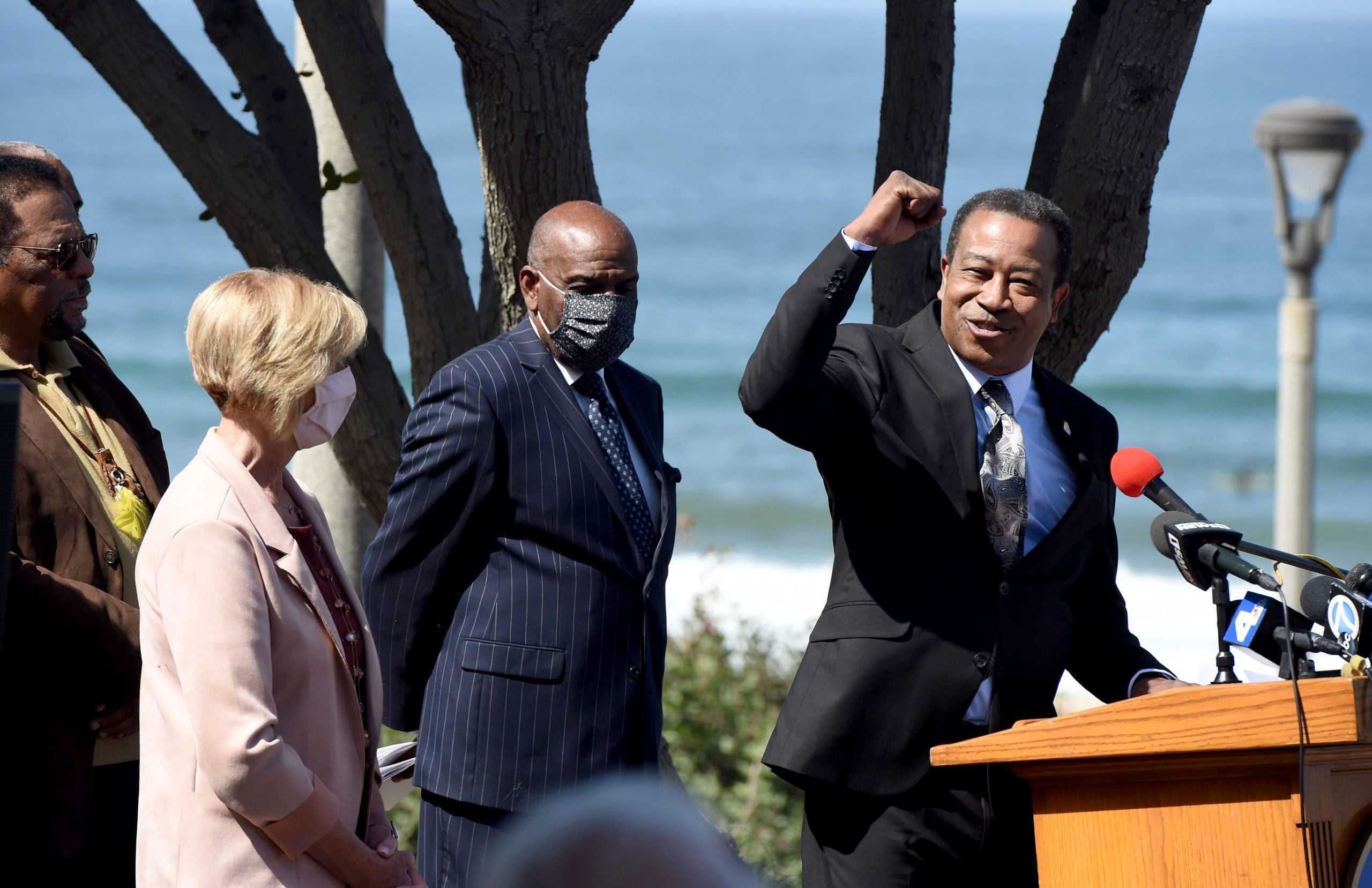
The chairman of the Legislative Black Caucus, Sen. Steve Bradford, D-Gardena, said he will champion the legislation in Sacramento, saying, “I look forward to working with the county getting this legislation signed into law this year.” The public seizure of the Bruce’s Beach property is much like other stories regarding Black people and land in this country. Black beach enclaves such as Sag Harbor and the neighboring districts of Ninevah Beach and Azurest—in the Hamptons—are facing similar circumstances. Due to an influx of real estate investors, rising property values, and are having issues to fend off both.
In 1912, Willa and Charles Bruce purchased land for $1,225. They added other parcels of land and created a beach resort catering to Black residents, who had few to little options at the time for enjoying themselves along the California coast. Complete with a bath house, dance hall and cafe, the resort became an oasis for Black families who hoped to create an ocean-view retreat. But, as Americans are seeing in TV shows like Watchmen, Lovecraft Country, and Them: Covenant—this Black resort quickly became a target of the Ku Klux Klan and racist white people who attacked visitors and vehicles viciously.
Undeterred, the Bruces continued to own-and-operate their small enclave, until the city condemned their property and other surrounding parcels in 1929. Eventually, the land was seized through eminent domain (see: Barclays Center in Brooklyn), and the resort was forced out of business shortly after in 1929. Families who lost their land sued and were eventually awarded some damages, but the Bruces, specifically, were unable to reopen their resort anywhere else in town. Despite using eminent domain to steal the land and “create a city park,” the property sat unused for decades. It wasn’t until 1960 that a park was built on a portion of the seized land. The exact parcel of land the Bruces owned was transferred to the state, and then to the county in 1995 and now currently houses the county’s Lifeguard Training Center.
The city park has become a variety of names over the years, but in 2006, Los Angeles county agreed to rename the park “Bruce’s Beach” in honor of the evicted family. A gesture that has been derided by critics, rightfully so, as a hollow gesture toward the Bruce family. The debate involving the Manhattan Beach City Council led to a resolution meant to acknowledge and condemn the city’s actions involving Bruce’s Beach. The resolution did not originally include an apology to the family, yet the council has agreed to install new historical markers at the site.
Chief Duane Yellowfeather Shepard, a descendant of the Bruce family, lashed out at the council, making it clear the family is still pursuing legal action to be fully reimbursed for the seizure of the land, along with restitution for lost earnings from what the resort would have earned over the past century, along with punitive damages for the institutional racism in this city that railroaded Black families out of the area.
Hahn has mentioned the county is in discussions with the Bruce family to discuss the future of the land, and the lifeguard training center. She remarks that one possibility is that once the land is returned to the Bruce family, the county could then lease it back to house the training center.