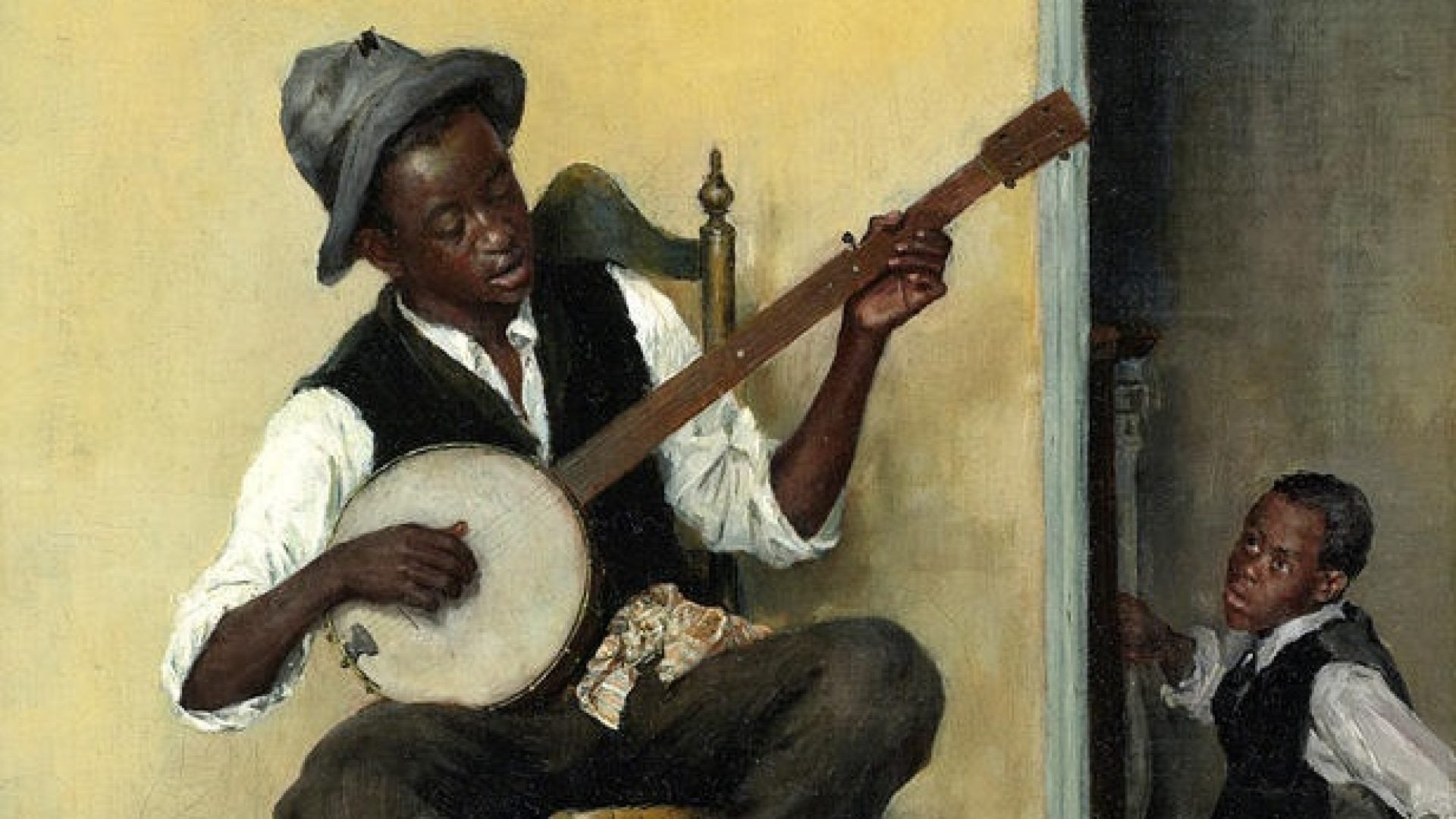

Early American banjo music is Black music. The banjo was created by enslaved African Americans, and according to the Smithsonian Institute, up until the 1830s, the banjo was exclusively an African American tradition. Banjo history has since been colonized and rewritten, but today, an increasingly growing number of people are ushering in a Black banjo revival.
The banjo is a time machine. For centuries before colonialism, its music connected our ancestors to place, history, and heritage. This can also be seen in the banjo’s role as a storytelling tool, its tunes often accompanying oral histories as they were passed down through generations. Later, it connected people who were stolen from Africa back to their roots and to their forebears. It was a slice of freedom for enslaved African Americans, a source of respite and resistance from the brutalities of slavery. Today, it still offers a sense of connection that transcends time and place.
But how do we contextualize this spiritual and material culture of the banjo? Black String Theory helps offer a foundation for that understanding. Ultimately, for Black communities in Africa and across the diaspora, music has never been about commodification, but about community.
“We have to first look at our family histories and understand that music has always been rooted in ceremony and spirit,” says folklorist, educator, and musician Sulé Greg C. Wilson. “Even the most ‘get down’ party is still a ritual and a ceremony. When our ancestors created their own music, everyone had the right and the opportunity to be part of that, and be part of the musical community.” Wilson notes that, in Black cultures, there traditionally is no separation between the sacred and the secular. “When you’re making music, you are bringing community together. You are bringing spirit down. You are conjoining the present, the ancestors, and the future. And so, Black String Theory puts our cultural instruments into a historical and futurist perspective.”
In pre-colonial Africa, the banjo’s predecessor, the akonting, was played at ceremonies, rituals, parties, and other occasions. These were sacred instruments that were meticulously crafted to create a unique sound. Traditionally, a large gourd was hollowed out to create the base of the instrument, and animal skin would be stretched across the gourd’s circumference. The handle was crafted from wood and attached to the base, and finally, the gourd banjo was strung using vines or animal-derived materials (gut strings).
As the transatlantic slave trade grew, enslaved people in the Americas and the Caribbean created their own versions of the traditional gourd banjo. In the US, banjo music could be heard on plantations across the American South, accompanying hymns, spirituals, and jigs, and being played in spaces where Black people (those who could) congregated amongst themselves.
Black String Theory also provides a framework to examine the colonization of the banjo itself. “The banjo was ours for nearly 200 years in this country, then European Americans started noticing it,” Wilson says. “After a few generations of it being seen by Euro-Americans, they started wanting to play it. Then, banjo music and techniques started getting documented, but all that documentation came through their lenses. There’s a thing in their culture that does not want to own up to where they get stuff from, especially if it came from people that they say are inferior. And as things from our culture are appropriated, because we do not have the dominating media, someone else’s third rate version of our stuff becomes the standard for it.”
Wilson founded Funky Banjo to teach the banjo using African and African American history, melodies, and techniques. His method books are unique in that there are not many banjo instructional materials written by Black people. Nonetheless, Wilson encourages Black people to give the banjo a try. “Don’t be scared. The banjo itself was invented by our ancestors to bring us together as a spiritual community, stretching from those long gone, all the way to those who haven’t been born yet. If you don’t believe it’s for you, it is.”
The banjo remained a fixture in Black communities well into the mid 20th century, where, alongside the fiddle, it was played in happy times and in hard times. After bringing the crops in, a party would be thrown, featuring the banjo. When shucking was done, the banjo would come out. Weddings, quilting parties, dances, and all kinds of other occasions found notes of the banjo permeating the air. As Slave Row became sharecropping quarters, and the Great Migration began to pick up steam, banjo music became less prevalent in Black communities. Add to that the introduction of new musical forms, plus appropriation and dilution of the instrument’s history, and the banjo slowly faded from Black households.
“When Black folks came back from being soldiers and workers in World War II, their work had been taken over by machines,” Wilson explains. “Where they used to harvest the cotton, tobacco, or corn, machines were doing that. So, the ceremony to end the cycle of harvest became obsolete because the culture had changed.” Along with changing cultural touch points came changing musical traditions. “The music changed because the ceremonies were different,” Wilson says. “Also, familial relationships were changing. Before, you had an extended family of 40, 60, 200 people on the farm or the plantation. Now, you’re becoming a nuclear family. And the instruments have to change to reflect the groove of the times.”
But today, people are again yearning for the banjo’s groove. At the end of April, the inaugural Biscuits & Banjos festival was held in Durham, North Carolina. The brainchild of Rhiannon Giddens, musician, composer, and cultural preservationist, Biscuits & Banjos uplifted Black banjo history and foodways, while creating space for Black country, folk, jazz, and blues artists. The three day festival was a combination of workshops, concerts, and film screenings, complete with onsite banjo lessons, an evening juke joint, and square and line dancing parties. Biscuits & Banjos launched this year in particular to honor the 20th Anniversary of the Black Banjo Gathering held in Boone, North Carolina in 2005, and will take place every other year going forward.
Giddens has been doing this cultural work for a long time, and says she is thrilled to see more Black people embracing and reclaiming the banjo. She uplifts traditional methods of learning and sharing banjo music, built on the foundational piece of community. When someone tells her they want to learn, she makes time to sit and jam with them for a bit. “It’s a very old model of apprenticeship where there’s no money changing hands,” she says. “You go to a person’s home or wherever, and you just sit and play. Joe Thompson was the last Black elder of this old string band tradition, at least in North Carolina, and that’s how we [her former group, the Carolina Chocolate Drops] learned it.”
For her latest album, What Did The Blackbird Say To The Crow, Giddens and former band member Justin Robinson traveled around North Carolina to record the tracks outdoors in the places where the music comes from. “We didn’t do any fancy arrangements, layers, or anything. We just put a microphone in front of each of us, got a great engineer, and just made the music,” she says.
“We did three different locations and worked with two African American elders from the tradition on the eastern side of the state. And we went to Joe Thompson’s house, to his yard, and played these tunes and recorded them. We also went to the Western part of the state, to Etta Baker’s house, who was an African American guitar player, and played tunes in her garden.” Though Thompson and Baker have both passed on, Giddens says she felt their presence as she was playing the songs, harkening back to the banjo’s way of connecting past to present.
This method of music making is very ancestral, calling up a time when anyone could join in and learn from the elders, and each other. “There’s something that’s really special about going back to the land that Black folks were on when we called up these tunes, and I think these recordings are really special because of that,” Giddens says. “We just thought that, these days, it would be nice to remind people where this came from, that it was community music before it was ever commercial music.”
Banjo music is Black music, but it is also a cornerstone of American music across the board. Sharing and contextualizing this history was part of Giddens’s goal for Biscuits & Banjos. “In American history, from the 1600s to emancipation, the banjo is such a Black instrument. Then, it is an instrument that everybody plays. Everybody. Then later, it ends up being reinforced as this white liberal instrument, which is part of a larger racist mythology..”
While learning the history of the banjo is empowering, it can also bring up complicated emotions for African Americans, especially those wanting to engage with the instrument in Black spaces. Hannah Mayree started The Black Banjo Reclamation Project to create spaces for Black people to learn the banjo together in community. “I understand feeling like the information was obscured,” Mayree says. “It’s our birthright, but many of us are just finding out about its history. What’s unique about BBRP is that we actually create Black affinity spaces, whether they’re within white spaces, or just completely self-produced experiences.”
Providing access to the banjo for Black people is one of the key things The Black Banjo Reclamation Project does. The organization hosts banjo builds, where they help participants build their own gourd banjos, then everyone comes together to play them. Also, they accept banjos from white musicians in the form of reparations, perform any repairs needed, and give them to students as part of a scholarship program. “I’m not here to stop white people from playing the banjo,” Mayree says. “But what I am here to do is ensure that, as Black people, we feel comfortable and centered in this space.”