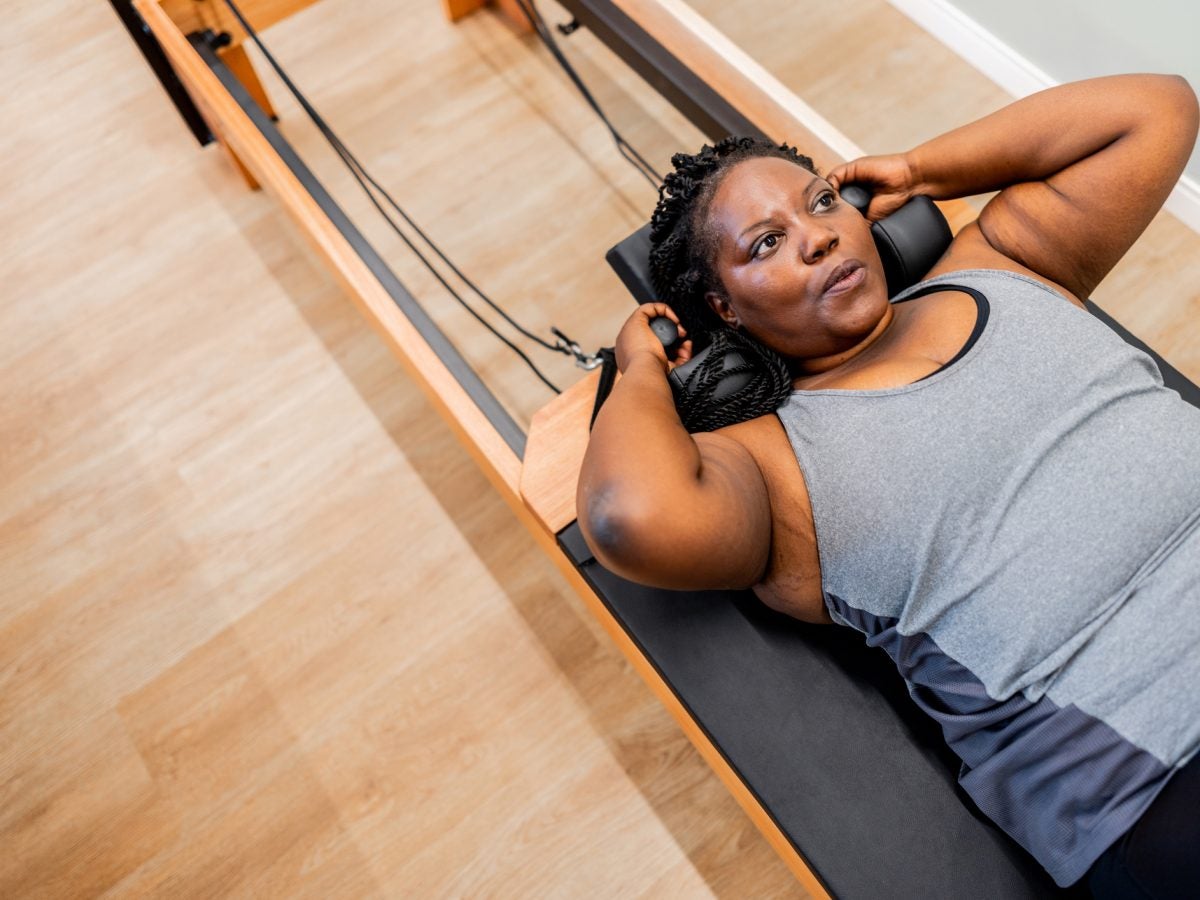

If you’ve been on TikTok within the last week, there’s a chance you’ve probably seen all the commotion surrounding Raven Ross, the Pilates instructor known for her platform, Pilates Body by Raven, and her comments on the reasons the ever-popular modality is not as diverse as it could be these days. Things went left when her overall point, which wasn’t really clear, sounded as though she were saying that Pilates is seen as a high-brow “legacy” form of movement, which requires a lot of training for instructors and therefore is a higher quality form of exercise, so it’s not going to be something you should expect to be diverse.
She talked about designer labels like Bottega Veneta, and how she thinks of them as being synonymous with “legacy,” “craftsmanship,” and handmade goods. “People check them over and over again to make sure the quality is there,” she said, adding, “You would never walk into Bottega and be like, ‘Where is the diversity? Where is the accessibility? Babe, there is no accessibility. This is Bottega.”
From there, she addressed newer Pilates students: “Pilates is a legacy. People have worked generations to preserve this method of exercise.” She noted that some “classically” trained instructors have done over 500 hours of training. Therefore, “nothing about Pilates is cheap.”
“Just to be clear, I’m all for the accessibility of Pilates,” she concluded, “but I do want some of the Pilates newbies to think a bit more critically,” mocking the tone of recent criticism at the very end. As people began to call out her comments, causing them to go viral, she deleted the video from TikTok and would later apologize.
Something that stood out most was, “Nothing about Pilates is cheap.”
Pilates doesn’t always have to be expensive, though. Ross, who provides what she labels “studio quality” Pilates workout videos for free should know that best. There are levels to the practice. One of my first experiences with Pilates was on a mat at a Lucille Roberts gym in downtown Brooklyn more than a decade ago. Lucille Roberts is an affordable gym, solely for women, and the rates at the time were affordable. They offered not just personal training at a reasonable fee, but an array of classes, including mat pilates, which was all about strength and lengthening of the muscles in the body, particularly participants’ legs, arms, and core. There I was, in an oversized T-shirt, Old Navy tights, locs in a messy updo, fighting for my life as I tried to do the pulsing movements. I was sweaty, but damn, I felt good. So I went back a few more times in between zumba and kickboxing workouts. It was part of my monthly fee, which I don’t think was more than $30, $35 then. The women in the class were Black and Latina, and the instructor was a young Black woman. Diverse, accessible, affordable.
In my years writing about wellness, I’ve also experienced the “luxury” side of it. Reformer classes in Williamsburg where I was one of maybe three Black women in the room. Private studio sessions in Battery Park, where an instructor, a Black woman, guided me one-on-one using a full Cadillac suite of Pilates equipment. That session was premium, and while I couldn’t afford to return outside of the trial I was given, I absolutely understood the value.
So yes, Pilates can be luxury. But it doesn’t have to be. Also important to note, diversity is not the same thing as accessibility, and neither are inherently tied to cheapness. Diversity is about inclusion of people from different backgrounds (racial, gender, socioeconomic, etc.). Accessibility is about lowering the barriers that prevent people from partaking in something. Now affordability? That does help to make something more accessible. But the way Ross framed it, it sounded like people asking for more inclusive Pilates spaces were really asking for a “discount” experience. That’s a strong thing to imply.
Wanting a more inclusive space makes sense, especially since a Black woman is connected to the growth of the method. Kathy Stanford Grant, a Black dancer, was one of the few people certified by Joseph Pilates. She was instrumental in expanding the practice in the 1960s and created space for more diverse students to experience the method. Don’t let today’s studio offerings fool you.
So I’m not surprised by the disappointment people are currently expressing with Ross, as what she shared was counter to her mission. Her platform has helped many people access Pilates through digital platforms. Her work has been about creating accessibility, as she noted, so to see her confused at the calls for more inclusivity felt like a contradiction. And when she imitated critics at the end of her video, it sounded like a dismissal of the valid concerns about today’s approach because they were coming from “newbies.” Newcomers who don’t understand the rules, and somehow, seek to cheapen Pilates.
It’s not wrong to be proud of your training, your business, or the quality of service you offer. But when that pride turns into a justification for why things don’t need to change, or why people shouldn’t expect inclusion, it gives gatekeeping. But wellness shouldn’t be exclusive. We should encourage more people to move their bodies in ways that feel good and empowering. And one of the most important factors in sticking with any exercise is feeling welcome in the space where it takes place.
If someone finds that Pilates helps them feel stronger, more grounded, more connected to their body and they’d like to see more people who look like them in the class, leading it, or creating the spaces, what is the problem? It’s fine to believe that your version of Pilates is high-quality, even luxurious. But to define the entire practice that way is a reach. Joseph Pilates created this method to build strength, mobility, and a mind-body connection. Good health and vitality are the real luxuries, and that should be the goal.
We live in a time where everything that grows in popularity eventually gets treated like it’s exclusive to some, and God forbid if it opens up to others. That logic shouldn’t be allowed in the context of wellness. If we allow gatekeeping to define who gets to enter a space, feel welcome in it, and practice self-care, then we’re missing the whole point of why we move in the first place.