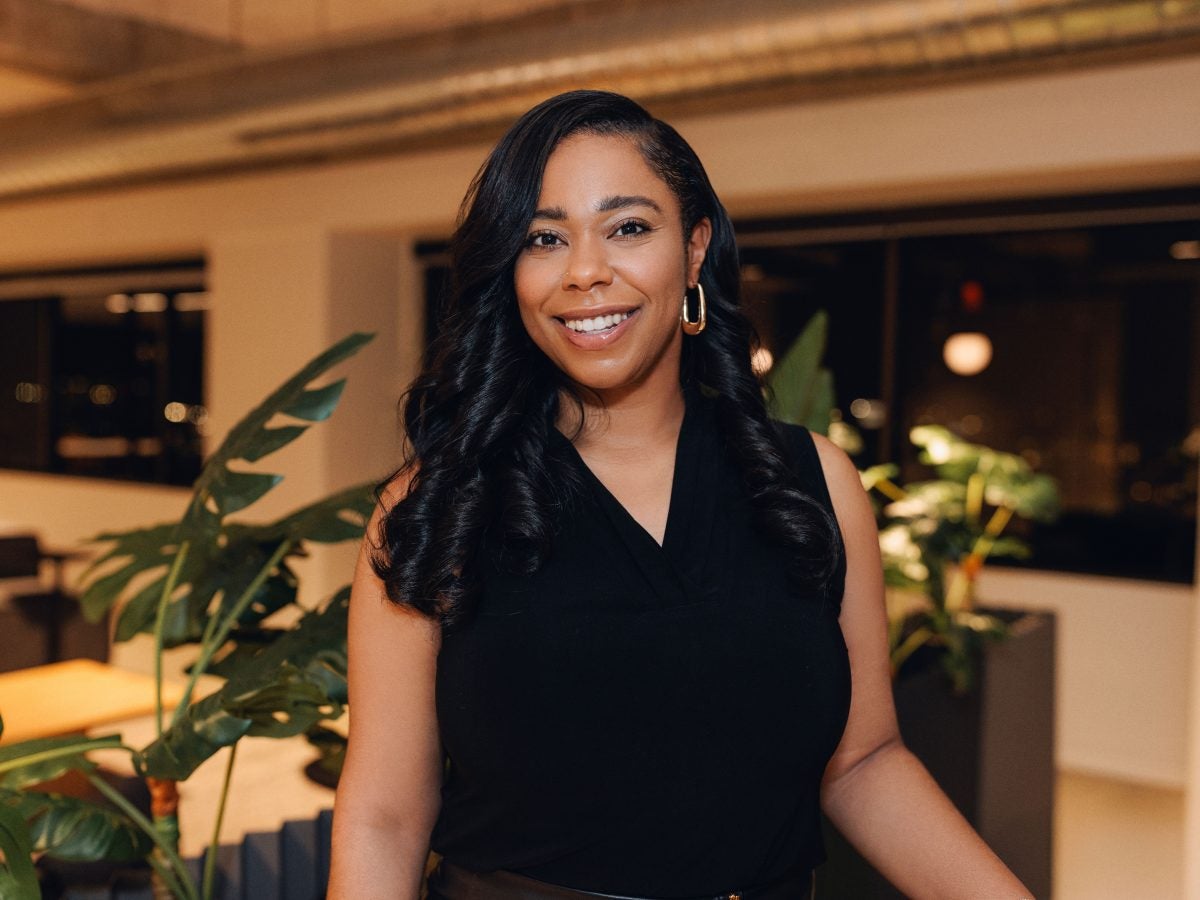

Ay’Anna Moody never planned to work in sports.
In fact, the Oakland native had her sights set on running for public office, ready to serve her community through traditional political channels. But when the Golden State Warriors came calling six years ago, something shifted. Now, as the executive director of the Warriors Community Foundation, a role she stepped into back in February 2025, Moody is doing exactly what she set out to do: serve her community. Just from a very different platform than she imagined.
“It’s crazy how my trajectory changed. But I ended up still doing the work that I was intended to do to serve the community.”
That commitment to community has yielded remarkable results. Under Moody’s leadership, the Foundation recently surpassed $50 million in total economic impact since its inception in 2012. But for Moody, it’s just the beginning. “I think we can definitely have 50 million more in 5 years just considering how we’re fundraising for the organization,” she says.
The reality is, Black women leading major sports foundations remain underrepresented (like most industries, if we’re being honest). While the NBA and NFL have made strides in diversity at the league level, executive leadership positions at individual team foundations don’t always reflect the communities they serve. Moody is part of a growing but still small cohort changing that landscape.
And what also sets the Warriors Community Foundation apart isn’t just Moody or the money (though both are definitely helping to push the organization to the forefront), but instead the holistic approach to support. The Foundation offers capacity-building training for youth development specialists, provides free community spaces in Oakland and San Francisco, and has created affinity groups specifically for Black women educators, which if you don’t know, is a rarity in sports philanthropy.
“I talk to my colleagues across the league and the NFL, and we’re the most generous foundation because we have different entry points,” Moody explains. “No matter where you are in your journey as a nonprofit, you might be a huge nonprofit or a smaller one starting out in the Bay Area, there’s room for you here.”
Growing up in Oakland, she watched her aunt co-found the Ella Baker Center for Human Rights alongside Van Jones. Those early experiences planted seeds that would bloom into a lifelong commitment to social justice and educational equity. Being from the Bay Area informs everything about how Moody leads. “We are the home of the Black Panther Party,” she says. “Just making sure we’re always pushing the element, making sure that we are creating programs that are innovative, being in this tech epicenter, but then also that we’re being responsive to what the community really needs.”
That responsiveness means maintaining close relationships with superintendents in both San Francisco and Oakland and having weekly conversations about challenges ranging from school closures to federal funding changes. It also means understanding that philanthropy isn’t transactional, it’s relational.
The Foundation’s signature initiative, Generation Thrive, exemplifies this community-centered approach. Launched in 2019 in partnership with Kaiser Permanente, the nonprofit accelerator has now served over 10,000 Bay Area educators with free professional development, wellness programming, and access to community spaces. But Moody doesn’t stop at established organizations. She actively seeks out emerging leaders, like Ahmed Muhammad, the first Black valedictorian at his Oakland high school who founded a STEM education nonprofit as a teenager.
“He graduated this past year in engineering from Stanford, and we started funding his organization last year,” Moody shares. “Just to see how he’s been able to use the resources to scale…having him in our orbit has really helped us to talk about the work in a different way.”
Still, leading at this level as a Black woman in sports philanthropy comes with unique challenges. Moody is refreshingly honest about her journey, admitting that her first year with the Warriors left her feeling like an outsider. She didn’t have the sports language yet. And she had to learn how to communicate mission and profit as a bilingual language, understanding that advancing organizational objectives and advancing community impact aren’t separate goals.
“I had to learn that and I had to be kind to myself because before I was really like, ‘Why am I not understanding this? Why am I not getting this?'”
Now, she’s passing those lessons on to younger mentees, teaching them how to communicate for impact and how to get their point across without being the loudest in the room. “Sometimes the quietest in the room get more done,” she notes. “It’s not about code switching. It’s about how you make yourself bamboo. You know what I mean? Flexible.”
But flexibility has its limits, and Moody is currently grappling with one of the hardest lessons for Black women leaders: the power of saying no. Being accessible, being present, being all things to all people—it’s a weight she’s learning to put down. “I want to be accessible, especially Black people, you never want to feel like you made it because then it’s like, ‘She acting funny. She act indifferent,'” she says vulnerably. “But it’s like I think people also don’t understand how much is asked of me inside of this organization and outside of this organization.”
Looking ahead, Moody has clear vision for what she wants the Warriors Community Foundation to be known for: being synonymous with educator support. The Foundation launched the first-ever educator appreciation night at Chase Center, and Moody wants to expand that recognition. “We want folks to know when you think about supporting educators, we want you to think about the Warriors and the Valkyries.”
She’s also dreaming bigger, envisioning a network of Black women in sports philanthropy who can share best practices and talk openly about salaries without the barriers of expensive professional organizations. “These young girls on TikTok, they are having conversations. They’re saying, ‘This is what I’m getting paid.’ We need to, as older women, start having those conversations too,” she says.
For now though, Moody remains focused on the work at hand: building what she calls a “reservoir of goodwill” that will sustain the Warriors’ community relationships long after star players move on. Because as she wisely notes, “community work is not charity work. At the end of the day, when we don’t have the Stephen Curry on our team, we still need to sell tickets.”