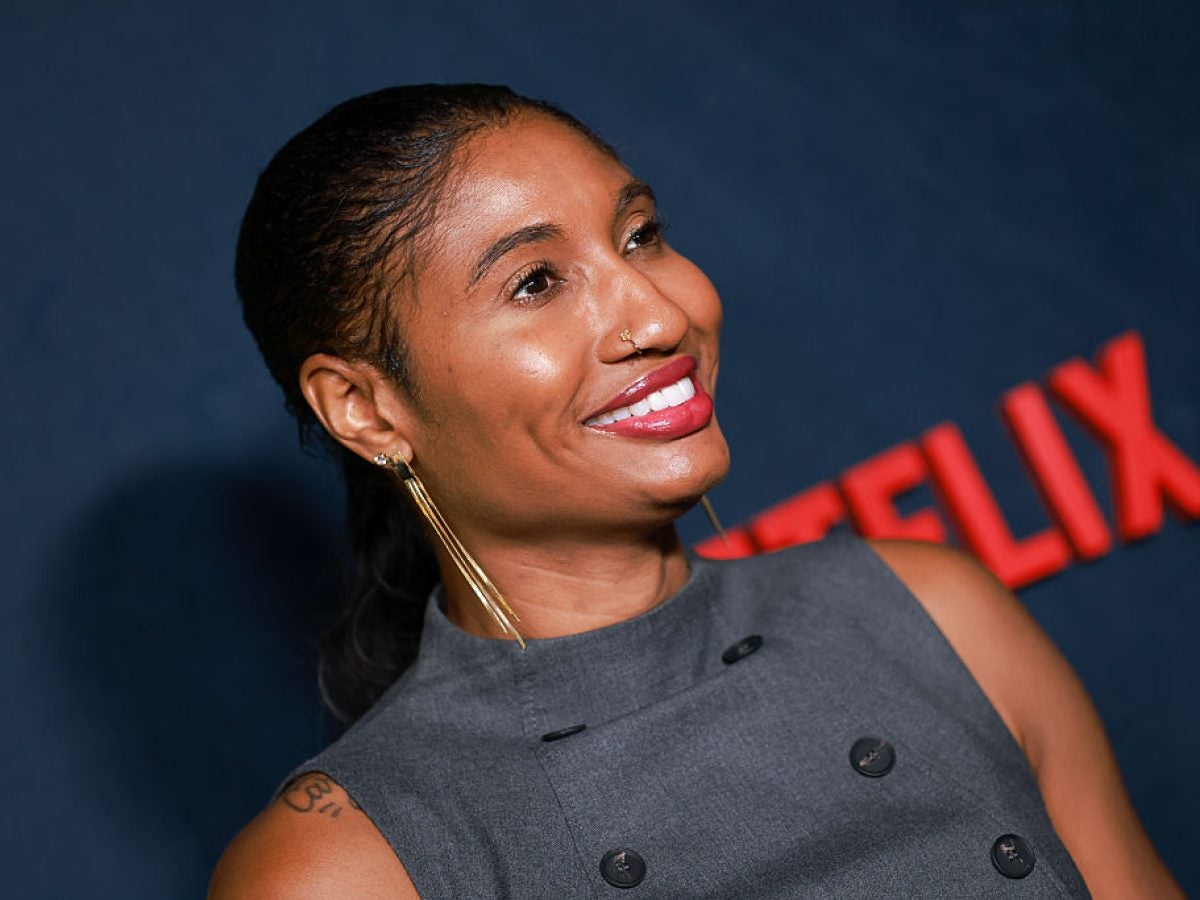

Angel McCoughtry knows what immediate validation feels like.
She’s played professional basketball for 13 seasons in the WNBA, won two Olympic gold medals and made multiple All-Star teams. Every shot, play and game gave her instant feedback because the scoreboard (and more importantly, the crowd) told her if it worked.
Unfortunately, filmmaking is nothing like that.
McCoughtry is learning this in real time as she preps her feature directorial debut Bolted for a March production start while simultaneously promoting Bygones, the short film she wrote and directed that premieres on Prime Video February 1st. The work is slower, quieter, and there’s no scoreboard to check.
“What felt most unfamiliar at first was the silence,” McCoughtry says. “In sports, everything is immediate feedback, reaction, validation. Filmmaking taught me to sit with the work without applause or judgment, sometimes for a long time.”
But that silence also opened something up. “That’s also what felt freeing,” she adds. “I could explore ideas, make mistakes, and grow privately. The process allowed me to reconnect with creativity for the sake of expression, not performance.”
One can only imagine this would be a weird space for someone whose entire professional life has been defined by performance and measurable results. But McCoughtry isn’t treating this like a retirement project or a celebrity side hustle (and honestly, completely fine if she were doing those things too). But instead, she launched McCoughtry Entertainment specifically to build a platform for stories that don’t usually get told and the voices that get overlooked in traditional Hollywood pipelines.
“I’ve spent my life inside systems where stories are often told about you, not by you,” McCoughtry explains. “I wanted to move from being the subject to being the architect. McCoughtry Entertainment gives me the freedom to tell stories with intention, nuance, and truth, especially stories that don’t always get the space they deserve.”
Bygones made sense as her first project because it’s about things she’s been processing in her own life. The film follows Charissa, a young basketball player who’s lost her confidence, and JJ, a former coach with a complicated past who becomes her mentor. Their relationship deepens until a painful secret emerges, one that ties JJ’s history directly to Charissa’s family. It forces both of them to reckon with forgiveness, accountability, and whether healing is even possible when trust has been violated that deeply.
“Bygones felt personal without being literal,” McCoughtry says. “It explores unresolved emotions, quiet reckonings, and the things we carry forward even when we think we’ve moved on. As my first project, it mirrored where I was in my own life, reflecting, processing, and learning to sit with what’s unfinished. It was a story I needed to tell before moving on to anything else.”
Mentorship anchors the whole film, which makes sense given how much coaches shaped McCoughtry’s own life. Not just her skills on the court, but her entire understanding of what good guidance looks like. “The best mentors in my life didn’t just teach skills, they created safe spaces for growth and accountability,” she says. “They told me the truth even when it was uncomfortable, and they believed in me before I believed in myself.”
That experience informs the dynamic between Charissa and JJ in the film. “That shaped how I see guidance: it’s not control, it’s trust. It’s knowing when to push and when to listen. Bygones reflects that balance, the impact mentors have long after the lesson is over.”
McCoughtry was drawn to exploring how complicated these relationships can be, how they don’t always fit into simple categories.
Getting to this point required McCoughtry to completely rewire how she thinks about being a beginner. Athletes are conditioned to produce results fast and to equate their value with productivity and measurable success. She had to give herself permission to do the opposite.
“I had to unlearn urgency,” McCoughtry admits. “For so long, my value was tied to productivity and results. Giving myself permission to slow down meant redefining success, not as mastery, but as curiosity. I reminded myself that being a beginner isn’t weakness; it’s honesty. Slowing down allowed me to build something real instead of rushing into something familiar just to stay busy.”
That mindset is carrying over into Bolted and whatever comes after. “Long term, I’m drawn to character-driven stories that live in the quiet moments, stories about identity, connection, and transformation,” McCoughtry says. “My legacy as a filmmaker isn’t about volume; it’s about intention. I want to build a body of work that feels honest, expansive, and rooted in power, especially for voices that are often underestimated or unheard.”
It’s still early. Bygones hasn’t even premiered yet, but McCoughtry seems unfazed by not having immediate answers about whether the work is connecting. She’s done chasing applause. Now she’s focused on building something that lasts, even if it takes longer than she’s used to.