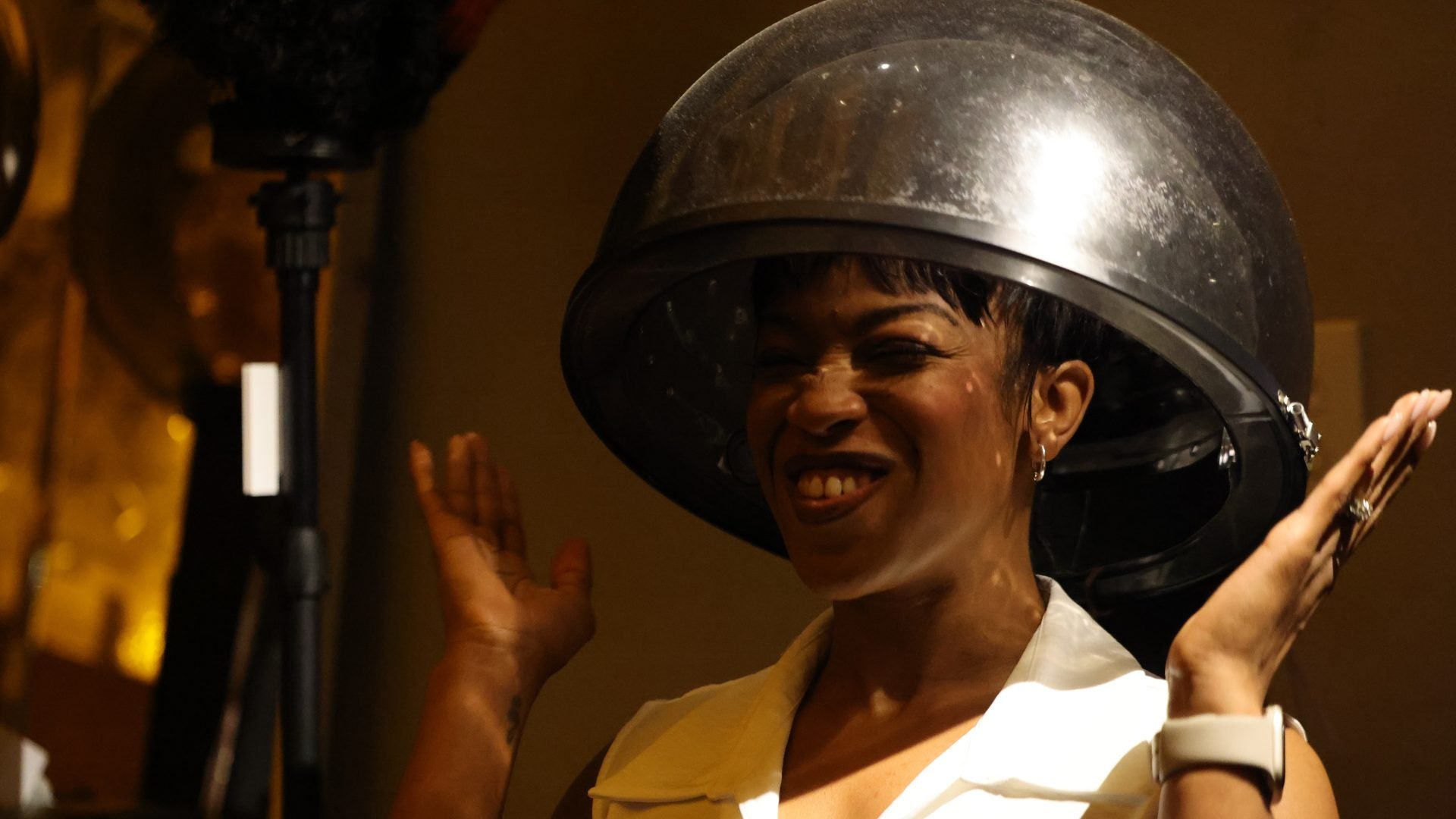

It’s a Sunday night at DreamGirls Hair Salon in Culver City, but something’s different. The usual hum of blow dryers and laughter is gone. In its place? Still Here, an immersive exhibit and live experience. The salon was transformed into a sacred stage, centering the lives and inner worlds of Black women living with HIV.
As attendees are soon reminded, Still Here is a beautiful testament to, and celebration of, what can bloom when the Black imagination thrives beyond the limits of societal boxes and traditional spaces.
Helmed by creative directors williambryantmiles and Nickolas Vaughan, and produced by WACO Theater Center with grant support from Gilead Sciences, Still Here made its Los Angeles debut from September 25 to 28.

The project embraces the Black salon not just as a setting, but as a cultural hub and healing space, rooted in a rich legacy of storytelling, beauty, and collective care. With upcoming stops in Houston, other Southern cities, and plans to bring the production to HBCUs, the work is deepening its impact as it travels.
This isn’t a show you simply watch. It’s something you move through, interact with, and at times, are invited to participate in. As audience members, we witness how an HIV diagnosis can shape the lives of Black women and girls.
The performance explores various ways HIV can be contracted—through unprotected sex, drug use, or from parent to child during pregnancy or childbirth—and the fear that can come with confronting the possibility.
We’re offered sobering statistics paired with empowering knowledge: options like PrEP, for example, are presented not as fear tactics, but as tools of care. Through it all, Still Here offers a balm: life continues. Joy, love, and meaningful connections remain possible beyond the sorrow, stigma, and isolation that often accompany a diagnosis.

Over 60 artists and technicians brought the vision to life, weaving theater, dance, documentary footage, music, animation, and narrative scenes into the rituals of Black hair care. And in a rare creative feat, everything from Miles’ and Vaughan’s original pitch deck made it into the final production.
A major North Star for the duo was examining how Black women with HIV have been portrayed in media, and re-centering those narratives in a way that felt fresh and culturally resonant.
“As two gay men, we can’t speak for Black women,” says Vaughan. “But what we can do is put Black women in the room and let them speak for themselves and we can learn from that.”
That ethos shaped everything, from the all-Black-women crew who filmed the My Girls conversation video, to the ensemble-based script development that invited cast members—or “creative collaborators,” as Vaughan and Miles call them— to bring their own creative ideas and truths into the work. “There’s no ‘written by’ credit,” says Vaughan, underscoring the commitment to true collaboration over hierarchy and control.

The result is tender, humorous, and at times, tear-inducing. When art not only entertains but offers something for your survival toolkit—perspective, language, a more expansive and humane way of seeing the world—it can feel like storytelling that’s also an act of love. A quiet, continuous I see you. I’ve got you.
“Art is an effective tool for change and impacting a community,” says Shay Wafer, Executive Director at WACO Theater Center. “The hair salon is a safe place for Black women which is why we chose it. It’s a place where we congregate, and it’s a place where we get our information as well.”
Tonya Thompson, Co-Founder of DreamGirls Hair, shares in the sentiment, noting how salons have long been communal healing spaces. “Still Here captured that spirit so beautifully, and I’m grateful DreamGirls Hair Salon could be part of it.”

Wafer, who once worked as a professional braider, remembers how clients would open up mid-appointment—grappling with joy, grief, relationships, health. “There’s something about the act of massaging the scalp and standing behind the person…they talk so freely. So we felt like stylists could ask questions and become the mouth, the conveyor of information.”
For Miles and Vaughan, the choice to focus the setting in a salon just felt right. “My and Nickolas’ work is, by definition, almost site-specific and ‘nontraditional’ and so it was never going to be in the theater for us,” laughs Miles. “That’s just how we move. We wanted a space where Black women would feel comfortable, from the most sophisticated theater and opera aficionado to someone who hasn’t been to any ‘cultural events’ and the salon is already theatrical with so many characters coming through. It’s the great equalizer.”
Both creative directors have deep personal ties to salons. Vaughan’s late aunt owned one, and he spent his childhood immersed in its sights and sounds. “The smells, the way in which people tell stories, the feeling of getting your hair washed in the bowls—I remember it so vividly. I was excited to bring that to life here and figure out, where can art live in this salon?”

As gay Black boys, Miles and Vaughan also recall the salon as a space of refuge from the harsher vibes of the barbershop. “Getting dropped off at the barbershop with my two brothers and waiting to get our haircut was painful because I never felt comfortable. I always felt ostracized. I always felt like I was a sissy. I was not man enough,” Vaughan shares. “But at the salon, I never felt anything but love and support. This is homebase for us.”
Miles reminisces on his own fond memories of the salon and channeling his self-expression through experimenting with hair colors and styles. “In 9th grade, I had this golden brown, not-quite-blonde––because that was a bridge too far––auburny color in a teeny weeny afro. I probably had way too much Vaseline on my lips, lips bussin’, I always had glossy lips,” he says. “And I went through this phase where I’d wear the same color every week in school, like this is my yellow week, this is my blue week, and orange week and I’d change my shoelaces that color.” That self-expression was welcomed in the salon, reflects Miles.
The cast—Marinda Anderson, Neverending Nina, Milan Reneau, Jude Tibeau, and Akilah A. Walker—imbue the stories with grace, depth, and vulnerability. Behind the scenes, movement director and choreographer Roxi Victorian, tech designer Luna Lux, and legendary costume designer Ceci help shape the sensory world of the show.

Ceci’s involvement carries particular weight: she also designed the costumes for A Different World’s pivotal 1990 episode in which Tisha Campbell’s character, Josie Webb, revealed she was HIV-positive—an early and unforgettable portrayal of a Black woman living with HIV on national television.
Black women accounted for approximately 50% of new HIV diagnoses among women in the U.S. in 2022, yet are still largely excluded from public health messaging and face structural barriers to accessing resources and preventive care. Still Here refuses to let those stories remain on the margins.
The experience also models a new kind of public health storytelling: one rooted in culture, not clinical settings. One that empowers people to talk to their friends, their loved ones, their partners, themselves.

And it’s not stopping there. A Still Here magazine is coming this winter to continue the conversation in print, featuring personal essays, art, photography, and interviews.
In the post-show Q&A, the final question of the evening is posed: What might the world look like if it truly changed—if Black women were seen, supported, and cared for?
“That world is whatever [Black women] want,” says Miles, pausing to think. “I can’t prescribe or define that, but I would imagine it’s a world where she can walk into the room with her joy first,” he says. “Where everything is just going so wonderful that the heaviest thing on her heart is something light. The trivial things become the big things because the big things have gone away.”Still Here doesn’t pretend to fix everything, but it makes space to imagine what healing could feel like, and it stays with you.