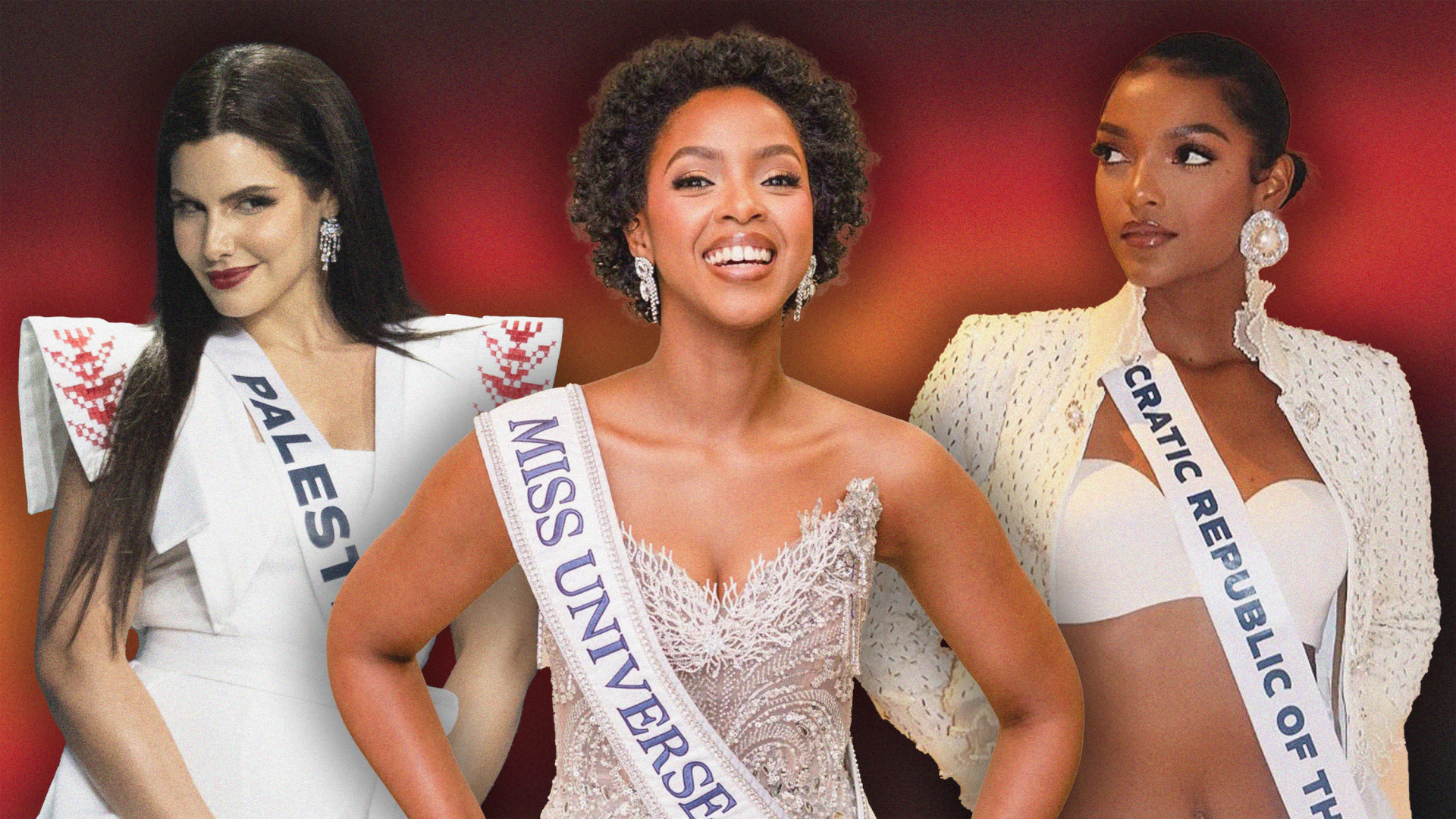

As glamorous contestants prepared for the annual Miss Universe Pageant, and competed for their countries on an international stage in the sport of beauty, a few notable changes were made to the competition that have garnered global engrossment. In the last few years of worldwide political unrest, a few countries have ironically been introduced to the Miss Universe lineup that were previously not included. Last year was the first time The Democratic Republic of Congo was represented in the pageant in almost 40 years, and, this year, Palestine was also recognized.
Palestine and Congo have become mainstream kitchen-table topics in households around the world for at least the last 2 years. Despite where people stand on the co-occurring genocides in Gaza, the worldwide political awareness of these countries render their “introductions” to the Miss Universe stage in this time more-than-ironic. In effect, questions of the value of representation resurface; how does representation—in this case, how successfully people from oppressed nations can subscribe to international beauty ideals—benefit or harm the work of liberation for their country’s people, if at all?
To represent Palestine this year in the pageant was Nadeen Ayoub, A Palestinian-born, Canadian-raised model and AI entrepreneur. Though people around the world are excited about her presence in the competition, including those who align with the justice and resistance work of Palestinian people, Nadeen is interested in being seen beyond the lens of Palestinian violence. She emphasizes that her role in the pageant signifies Palestinians as, “more than our suffering—we are resilience, hope, and the heartbeat of a homeland that lives on through us.”
Though it is true and noble to remind the world that Palestinian people exist beyond struggle, her sentiment is a common angle among liberal people of color in these arenas, where the girls keep it cute, marketable, and humanitarian only to the extent of universal palatability. The pitfall is that their desires to be included often ends up reframing identity in contexts that are western, capitalistic, and exploitative, all to be validated by a world who values its delusions.
There is also validity to disenfranchised people to crave belonging in spaces outside of oppressive contexts that pigeonhole their identities and narratives. The issue here isn’t about how we are represented on social platforms, but instead the value of the platforms on which we desire to be represented. Amidst amplified resistance by marginalized people against oppressive values that platforms like Miss Universe upholds (including beauty!), there is a dire need for marginalized people to recontextualize decolonial dreams—what spaces our narratives beyond colonial contexts can really thrive in.
Another example involves the Congo’s new involvement in the pageant. Last year, Ilda Amani became The first Miss Democratic Republic of the Congo to compete in the Miss Universe Pageant in 40 years. The timing seemed strange, as it fell curiously in tandem with the Congolese liberation movement picking up in mainstream momentum. Amani had been active as an advocate for women in The Congo, especially as it relates to menstrual and sexual justice.
This year’s contestant saw Dorcas Dienda Kasinde vying for the crown, a model and humanitarian whose efforts to raise awareness and provide education and resources to children in Congo is a large part of her Miss DRC platform. She often cites the harrowing consequences of the ongoing conflict in Congo, educating a global community that has largely been silent about genocide in the country.
For women to bring issues of struggle to an international stage, even in an arena like beauty that seems far removed from relevance, is always exciting and motivational. But as marginalized people have also been largely mistrustful of capitalistic, commercial platforms that exploit, commodify, and pacify struggle, there is a real fear of bedazzling and spectacularizing these pivotal movements, which may risk harm. This is not of any fault to the participants; for a multi-billion dollar capitalistic platform to suddenly give space to women who represent countries under siege feels awkward at best, pacifistic at worst. This is especially true as the country’s respective freedom movements are inherently anti-capitalist and critical of commercialist spectacle.
Every beauty contestant need not be a protestor, and there are many valid forms of resistance beyond radical protest. In fact, there is real grief in projecting “protest” and “radicalism” onto the actions of everyday people who are simply honest about circumstances in the global south that affect us all. The truth is only deemed “radical” in social spaces tethered to lies.
So here is the truth we don’t like to name: the same violence that afflicts people in countries struggling against colonialism shows up on the other side of the coin—just as violently, though camouflaged in a new, glamourous setting, and under the facade of more “beautiful” management. Platforms like Miss Universe that encourage women to aspire to glamorous beauty ideals and dainty political messaging are as horrifying as the oppressive violence inflicted upon marginalized people from the countries of these contestants; no one in either reality can truly afford freedom.
Granted, it is true that women from these contexts who can show up beautifully, poised, and unbroken can sometimes be its own statement. The joy of being beautiful feels like it should be enough, that women from lineages of struggle can carry it with poise, beauty, and grace, in spite of reality. In a way, it signals that the very people that the world works hard to disappear are still here, and are shining. But it may cost collective integrity, depending on who we allow to define and steward the archives of our beauty.
So what if we let them have it—the pageants, the crowns, the titles owning universal beauty? Can we collectively let our beauty redefine itself, for its own sake, on its own terms, instead of for the games of empire and patriarchy? Where does our beauty feel safest and freest? What part of our beauty is truly, sovereignly ours?