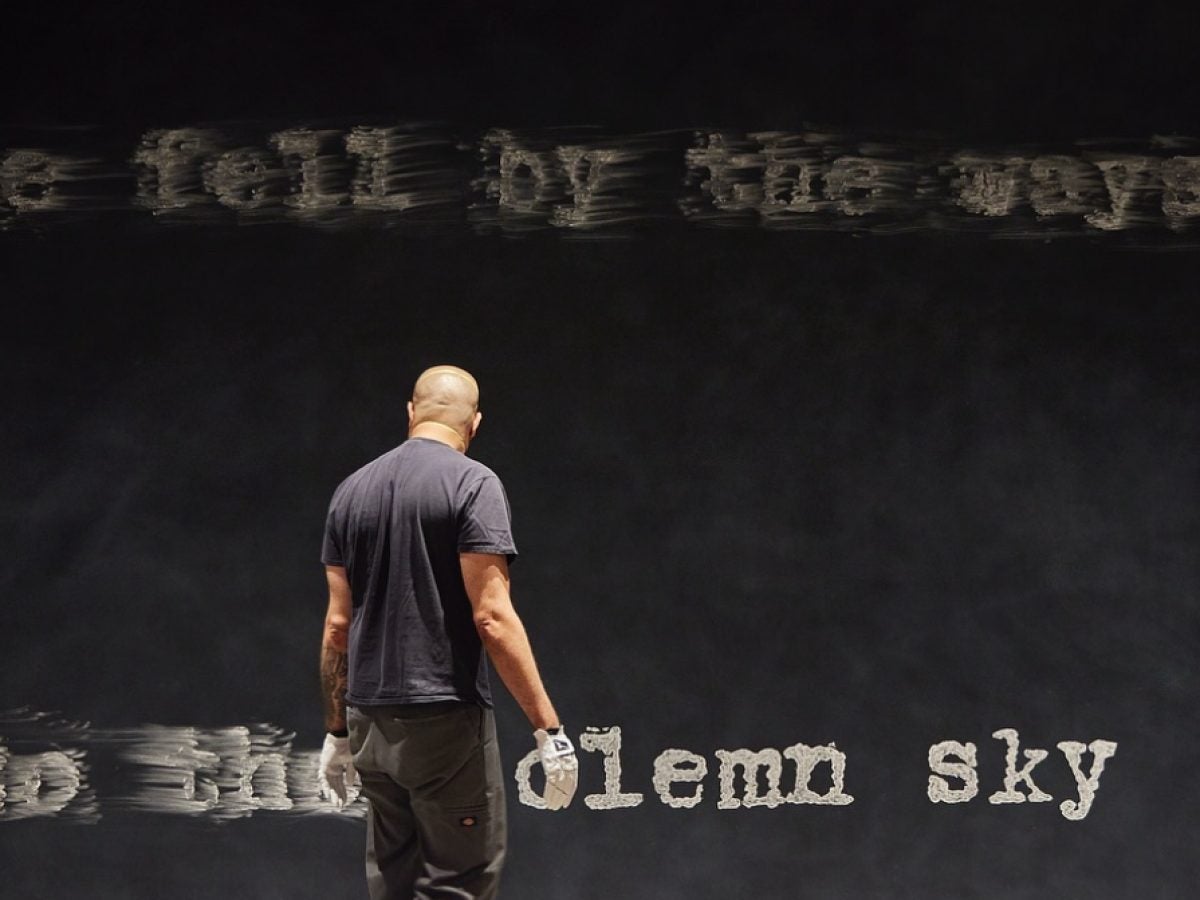

Gary Simmons’ Rush, housed at the Cookie Factory in Denver, is an immersive meditation on movement, memory, and what gets erased in the recording of American history. Known since the late 1980s for using erasure as a concept, Simmons extends his practice here into an architectural scale, transforming the main gallery into a vast blackboard environment where images emerge, blur, and refuse to fully disappear.
Blackboard has long been utilized as a central surface in Simmons’ work. In Rush, chalk lines are drawn and partially wiped by hand, leaving behind smudges and residues that hover between being seen and unseen. The physical engagement with drawing remains foundational for Simmons, even as the work expands into immersive space.
“Everything is based in drawing for me,” the artist said during an exclusive preview of the exhibition. “It’s one of the purest forms of communication. If I said, ‘Hey, how do I get to this destination?’ You would draw me a map. And it’d be a crude map, but I would probably understand it.” Drawing, for Simmons, carries honesty because it allows for mistakes and revisions, making every stroke more intentional than the last.
In Simmons’ new work, these “maps” lead directly into Colorado’s role in the mythology of westward expansion. The exhibition title references Charlie Chaplin’s The Gold Rush, invoking long-standing American ideals of persistence, ambition, and progress. Simmons centers two enduring frontier symbols (the cabin and the covered wagon) drawn from both Chaplin’s film and the history of the Donner Party. Placed on a medium often associated with education, these slightly distorted images serve as lessons that remain unresolved.
Jérôme Sans, the exhibition’s curator, positioned the Cookie Factory as a site that deliberately avoids cultural isolation. “Most museums around the world are not surrounded by homes, they are surrounded by life,” he said. “That is the beauty of this place.” Rather than sealing itself off from the city, the space opens itself to the outside. Co-founder and Executive Director Amanda J. Precourt echoed that sentiment, speaking to the location’s accessibility. “We are free to the public,” she noted. “And we are privately funded so that we can be in collaboration, not in competition.”
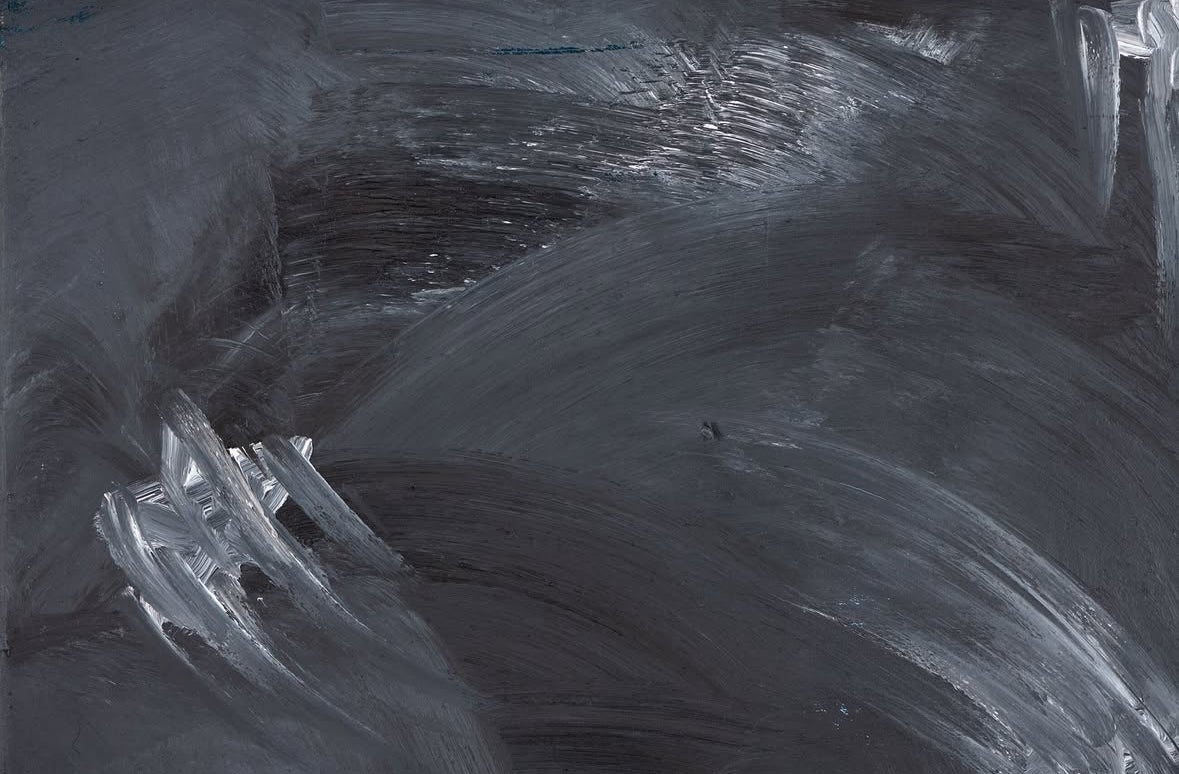
Born in New York in 1964 and of West Indian descent, Simmons has consistently drawn from popular culture such as cartoons, cinema, and sports, to expose how systems of racial and social power embed themselves early. During the exhibition’s opening night, he recalled a childhood memory that continues to shape his practice: entering a classroom and seeing faint chalk marks left behind from the previous lesson.
“You’d erase it and there’d be little flashes,” Simmons said. “I’d always try to figure out what they were learning before we got into class.” At times, the lasting residue residue becomes a guiding image. With Rush, that dynamic expands outward, inviting viewers to draw their own conclusions of what deserves to be present or absent.
The theme of movement is prevalent throughout the exhibition in several ways. Simmons was intrigued by the building’s own transitions—from paper mill to cookie factory to abandonment to cultural space—and how closely that mirrored narratives of westward motion. Manifest Destiny promised an endpoint of prosperity, but the routes toward it were defined by trials and tribulations. “There were all these routes and paths and corridors that had to be navigated,” Simmons said, “and there was a lot of slippage and death and all kinds of other unfortunate things along the way.”
For the first time, Simmons introduces sepia tones into his wall drawings in Rush, because it evokes historical distance while drawing attention to how history is staged and preserved. In an era of accelerated image culture, he argues, decay happens instantly. “Images become ruins the moment they appear.” Shooting stars also recur throughout the exhibition, flickering as symbols of aspiration and impermanence.
“There’s a joy and a wishfulness to them,” the 61-year-old said, “but there’s also tragedy.” He described how rare they feel, how people remember exactly where they were when they saw one. “As soon as you see one, the idea is that you make a wish on that star and you don’t tell anybody what that dream is.”
As Rush continues its run, the work is meant to be consumed on different occasions. The drawings, gestures, and references are designed to soften over time, allowing time to distort and rearrange what was seen.
“People are going to leave here with a certain kind of fractured memory of what they saw,” Simmons said. “They’ll fill in the gaps with things that maybe never existed in the room, and that’s okay. That’s how memory works. It keeps moving. And that doubling—this work being about erasure, and then erasing again as it lives on in someone’s mind—that’s really where the power is for me.”
Gary Simmons’ Rush is on view at the Cookie Factory through May 9, 2026.